


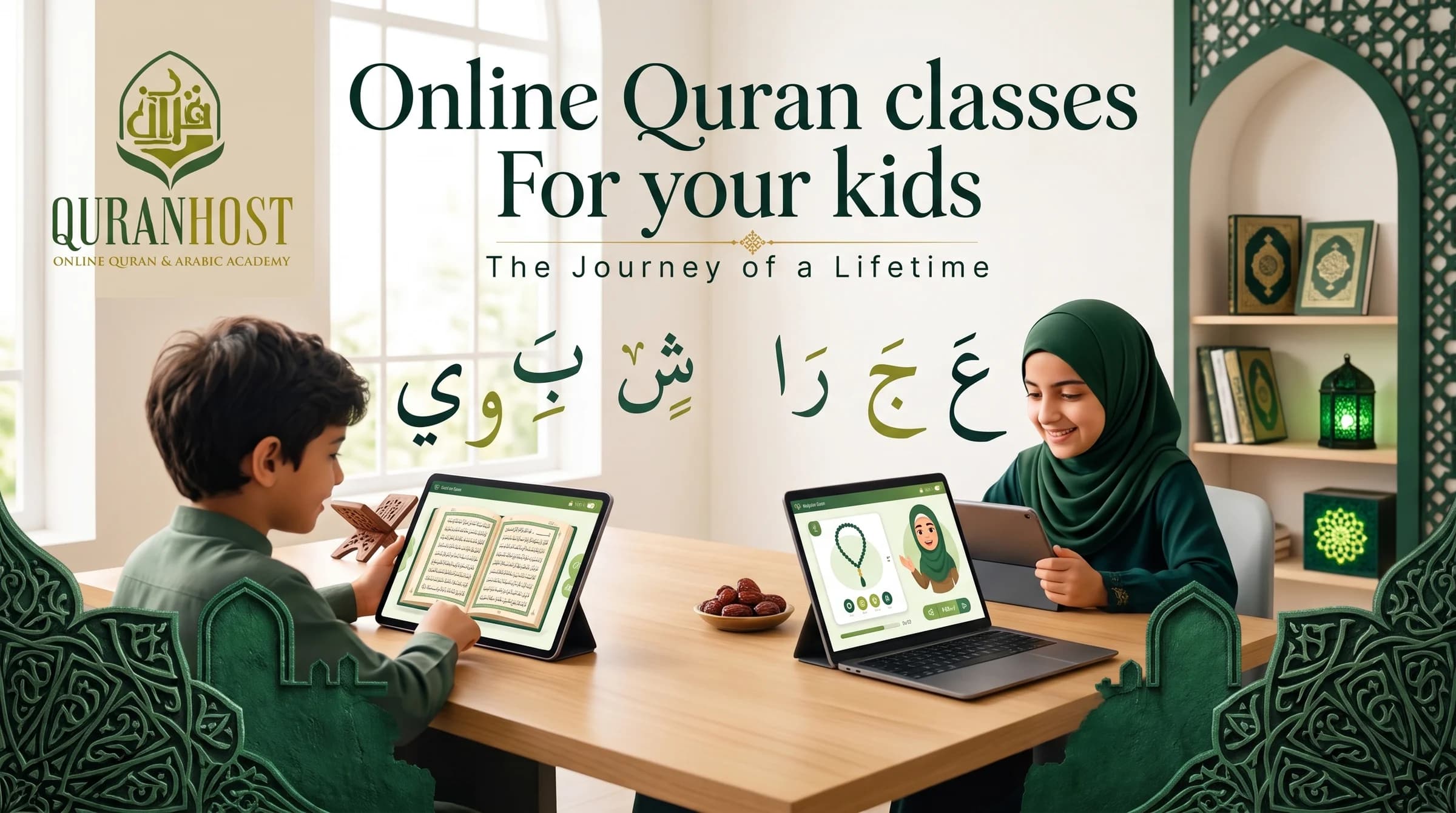
If you are raising Muslim children in the UK, the USA, Canada or Australia, you already know the squeeze. School, homework, clubs and sport fill the week, the nearest mosque class may be a drive away at a fixed hour, and the Quran ends up as the thing you keep meaning to start.
Online lessons changed that arithmetic. A child can now sit with a qualified teacher for half an hour at the kitchen table, at a time that fits around school, with a parent within earshot. The Prophet (peace be upon him) said, “The best of you are those who learn the Quran and teach it” (Sahih al-Bukhari 5027), and for most families online lessons are simply the most realistic way to make that part of a child's week. If you are still weighing online lessons against the local madrasah, our guide on how the two options compare for children sets out the trade-offs on both sides.
This guide is about getting started rather than about picking a provider. It covers when a child is ready, what a first lesson actually looks like, the path they will follow, and what you as a parent can do to make it stick. If you are still comparing providers, our guide on how to choose online Quran classes covers that separately.
Is my child ready to start?
There is no single right age, and readiness matters more than the number. What actually predicts a good start is whether a child can sit and attend for fifteen to twenty minutes, follow a simple instruction from an adult on a screen, and repeat a sound back when asked.
In practice that puts most children somewhere in this range:
- Around 4 to 6. Short, gentle sessions on letter recognition and sounds. Expect play, repetition and tracing rather than anything resembling a lesson. Twenty minutes is plenty.
- Around 7 to 10. The strongest starting window for most children. They can concentrate for a full session, and reading fluency plus introductory Tajweed moves quickly.
- 11 and above. Starting later is not a disadvantage. Older beginners usually move through the foundations faster because they can absorb rules rather than just imitate sounds.
A child who is not ready will show you within two sessions. That is a reason to pause for a few months, not a verdict on them.
If you want the readiness signs in more detail, along with the order children learn things in, our guide on when to start teaching your child the Quran goes further into both.
What a first lesson actually looks like
Parents often picture a lecture. It is closer to a reading session with a tutor.
A typical lesson runs about 30 to 45 minutes on a live video call, one child and one teacher. The first session is usually mostly assessment: the teacher finds out what your child already recognises, listens to them attempt a few letters or a short surah, and sets a starting point. Expect a digital whiteboard, colour-coded letters, and a lot of the teacher saying a sound and your child saying it back.
What makes it work for young children is that nobody else is in the room. In a group, a shy child can hide at the back for a term. One to one, the teacher hears every syllable, corrects immediately, and moves at the child's speed rather than the group's.
Most academies, including QuranHost, let you take a free trial class before committing, which is the cheapest way to find out whether your child and a particular teacher get on.
The path your child will follow
Almost every reputable programme follows the same sequence. Knowing it helps you tell real progress from busywork.
- Noorani Qaida, the foundation. Recognising the Arabic letters, their correct sounds, and joining them into words. This is where the articulation points, the makharij, are built. Rushing it is the single most common cause of problems later.
- Quran reading with Tajweed. Once the letters are secure, your child reads from the Quran itself and applies the rules of recitation as they go, rather than learning them as abstract theory.
- Memorisation, Hifz. Usually beginning with the short surahs of Juz Amma, which are also the ones used in prayer. Good programmes spend as much time on revision as on new memorisation; without that, what was learned in March is gone by June.
- Islamic studies and character. Alongside the reading: the daily duas, how to pray, and the manners that the memorisation is supposed to produce.
How long each stage takes varies enormously by age and by how often a child practises between lessons. Be wary of anyone promising a fixed timetable for your particular child.
QuranHost teaches this pathway through its online Quran classes for kids, with separate courses for Noorani Qaida, Quran reading with Tajweed and memorisation.
Each of those stages has a guide of its own: what the Qaida stage involves and how to keep a young child engaged in it, what parents can do while a child is memorising, and what a structured Islamic studies course should cover.
What parents actually need to do
This is the part that decides outcomes, and it is the part least discussed. The teacher has your child for perhaps ninety minutes a week. You have them for the rest.
- Sit within earshot, at least early on. You do not need to understand Arabic. Being nearby tells your child this matters, and it lets you hear how the teacher works.
- Five minutes of practice beats one long session. Reviewing the same few lines daily is what moves a child forward. A single catch-up before the next lesson does not.
- Protect the slot. Lessons that get moved for every fixture and party quietly stop happening. Pick a time you can actually defend.
- Celebrate small landmarks. Finishing a Qaida chapter or a new surah is worth more attention than it usually gets.
- Ask for feedback and read it. QuranHost provides regular lesson updates and monthly progress reports; ask specifically what your child is finding hard, not just whether they are doing well.
One more thing worth saying plainly: keep the pressure off. A child who associates the Quran with being told off will carry that for years. Consistency and warmth outperform intensity.
If lessons are turning into a battle rather than a routine, our guide on making Quran learning easier for a child has nine practical things to try.
Questions worth asking before you enrol
Whichever academy you choose, these are the ones that tell you most:
- Who exactly will teach my child, and what are their qualifications? QuranHost's tutors are Ijazah-certified and are vetted, trained and monitored, and include native Arabic speakers as well as teachers fluent in English, Urdu, Hindi and Pashto.
- Can we have a female teacher? For many families this decides everything. QuranHost has qualified female Quran teachers available.
- Is it genuinely one to one? Some providers advertise personal attention and deliver small groups.
- What happens if we need to change or stop? Check the pricing and the refund policy before you pay, not after.
- Can we try a teacher first? A trial tells you more about the fit than any brochure.
Our separate guide on how to choose online Quran classes goes through the comparison in more detail.
Ready to see how your child gets on?
QuranHost teaches children one to one with qualified male and female tutors, around your family's schedule, from Noorani Qaida through to Tajweed and memorisation.
See our online Quran classes for kids or book a free trial class. The trial is free, with no card details required.
Online Quran Classes for Kids: Parent FAQs
The questions parents ask most often before their child's first lesson.
A note on expectations
Progress in Quran learning is not linear. Children plateau, particularly partway through the Qaida and again when memorisation revision starts to outweigh new material. That is normal, and it is usually the point at which families give up just before things click.
Aim for a child who reads a little every day and enjoys the lesson. That combination finishes the Qaida, then the Quran. Intensity without consistency does not.
Further reading for parents
The guides below go deeper into each stage of this one.
- When to start, and what to teach first: readiness signs and the order children learn in.
- Online lessons, a madrasah, or a tutor at home: the four ways families learn, and what each one suits.
- The Noorani Qaida stage: what it covers, and six habits that help beginners through it.
- Keeping a child motivated: nine practical things parents can do.
- Supporting a child through Hifz: the parent’s role during memorisation.
- Islamic studies alongside the Quran: aqeedah, worship, Seerah and manners.
- Comparing academies: the full checklist for choosing a provider.