


Learning the Quran Online: A Comprehensive Guide for Children
Learning the Quran holds a holy place in the Islamic culture. A Quran learner is considered a respectable person in the Islamic society. It is an important aspect of the Islamic teachings. Allah and the last prophet Muhammad (P.B.U.H) told the Muslims about the importance of learning the Quran. The Rasool of Allah said:
“The best among you (Muslims) are those who learn the Qur'an and teach it.” (Bukhari).
Learning the Quran is the need of every person in a Muslim society, and for young children that need multiplies many times over. As a parent, it is your religious obligation to see that your children learn the Quran. What has changed in recent years is not the obligation but the range of ways to meet it. This guide sets out the options open to families today, why so many parents now choose online lessons for their children, and what to check before you enrol.
If you have already decided and want the practical steps, our starting guide for parents covers readiness, what a first lesson looks like, and what parents need to do once lessons begin.
Four Ways Children and Adults Learn the Quran Today
Before comparing online lessons with the alternatives, it helps to see the full range of options open to a family. Quran teaching for children matters as much as it does for adults, and the method that suits one household will not always suit another.
| Way of learning | What it involves, and who it suits |
|---|---|
| A private tutor at home | A qualified tutor comes to the house and teaches one to one. The attention is excellent, but you are limited to whoever teaches in your area, and home tuition is usually the most expensive option. |
| A madrasah or masjid | The oldest route, taught in congregation since the time of the Prophet (peace be upon him). Alongside recitation, children absorb the manners, the prayer and the atmosphere of the masjid, which no screen reproduces. Classes are larger, so how much individual attention a child gets will vary. |
| Online one-to-one classes | A tutor teaches over a private video link at a time you choose. This suits families with no suitable teacher nearby, with crowded schedules, or who would rather lessons happened at home. It needs a reliable internet connection and a parent on hand to settle younger children in. |
| Self-study | Quran apps, recorded recitation and online courses. Useful for revision, for adults, and for new Muslims building confidence, but nobody is listening to correct your pronunciation as you read. |
Each of these has its place, and many families combine two of them. The rest of this guide looks at why the third option has become the practical choice for so many parents.
Where In-Person Quran Classes Can Be Harder for Families
For a long time an in-person class at a masjid or madrasah was the only realistic option, and for many households it remains an excellent one. For others, a few practical difficulties get in the way:
1. Hectic mode of learning:
The children had to go to the institutes physically at a specific time of the day to learn the Quran. It is a time-consuming process and consumes much time compared to the online method of learning. The online method of Quran learning is an easy method of learning the Quran in this way.
2. Parent’s responsibility to pick up and drop the kids at the institute:
In daily life, parents have different responsibilities. In this Quran learning process, it is the responsibility of the parents to pick up and drop the children from their institutes. They have no enough time to do so. It is the major problem in the conventional method of learning the Quran
3. Have to leave home to join an on-ground Quran institute.
In the process of learning the Quran from an on-ground institute, a child needs to leave his home. The parents of the children cannot supervise, that what is the score of their children in the class. There is a risk for the little children to leave their homes.
4. You can seek guidance from only a few nearby Quran tutors.
A family can only really choose from the teachers within travelling distance. In a small town, or in a country where Muslims are a minority, that may come down to one or two people, and neither may specialise in teaching young children or in the particular course your child needs. It is geography that sets the limit here rather than the teachers themselves, who are often doing a great deal with very little.
5. Lack of focus of the teachers on the students.
The tutor in an on-ground institute cannot focus on all the children in the institute equally because there are a lot of children in the class and all the children learn a different type and different topic of the Quran. So, it diverts the focus of the tutor in different directions, which can delay the Quran learning process.
Advantages of Online Quran Learning:
Set against those difficulties, online lessons solve several problems at once. Here is what parents most often say they gain:
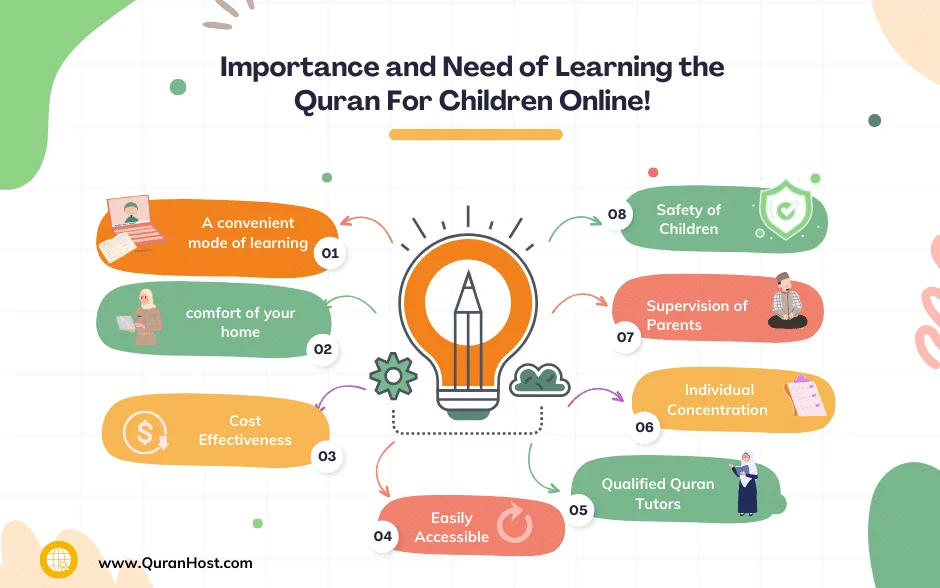
1. A convenient mode of learning
The online Quran learning process is more convenient as it is a click away from the learners. They can approach it anytime, from anywhere. There is no specific time and place for Quran learning online.
2. Learning the Quran from the comfort of your home.
Your child attends the lesson from the comfort of home, with no journey at either end of the class. That makes it far easier to keep lessons regular through school terms, dark winter evenings and Ramadan.
3. Cost Effectiveness
Online lessons remove the cost of travelling to a class and the premium usually charged for a tutor to come to your house. QuranHost also offers a free trial class with no card required, so you can see how your child gets on with a teacher before committing to anything. For current fees, ask the team directly.
4. Easily Accessible.
Because the teacher joins from wherever they are, families are not tied to whatever times a local class happens to run. Lessons are scheduled around your household’s routine, which matters most for families abroad, in a different time zone from their teacher, or fitting lessons around school and work.
5. Approach to Qualified Quran Tutors around the Globe:
Online learning widens the pool of teachers far beyond your postcode. QuranHost’s tutors are qualified and experienced, those teaching on the Ijazah pathway hold a valid Ijazah with a connected Sanad, and instruction is available in English and Urdu so a child who does not speak Arabic can still follow the corrections. You can request a male or female teacher for your child.
6. Individual Concentration on Every Student:
In a one-to-one lesson the teacher has one child to think about. Some children need longer on a letter or a Tajweed rule than others, and a private lesson can slow down or move on accordingly, without holding anyone else up or leaving anyone behind.
7. Supervision of Parents:
Lessons run on a private video link and parents are welcome to sit in. After each class you can read the teacher’s notes on what was covered, which makes it easy to spend five minutes revising the weak spots before the next lesson rather than waiting for a report at the end of term.
8. Safety of Children:
Your child learns at home. There is no journey to make after dark and nobody to be dropped off with and collected from. The lesson happens on a private video link, in a room you choose, and you are free to sit in on any class. No provider can honestly promise more than that, so it is worth asking any academy you are considering how its teachers are vetted and whether parents may observe lessons.
9. Quick Feedback Between Lessons
Questions do not have to wait for the next class. Children and parents can raise a problem between lessons, and the teacher’s notes after each class give you something specific to work from rather than a vague sense of how things are going.
10. Lessons Cover More Than Recitation
A Quran teacher does not only teach reading. Depending on the course you choose, lessons can also take in the kalimahs, how to offer salah, the everyday supplications and basic Islamic manners, so that what your child reads is connected to how they live. Courses differ in how much of this they include, so say what you are looking for when you enrol.
Online Islamic Classes for Girls and Women
For many families the decision is not only about convenience. Parents who would prefer their daughter to be taught by a woman are often limited by whoever happens to teach locally, and older girls and women returning to the Quran may not want to travel to an evening class alone or study in a mixed group.
Online lessons make that choice straightforward. QuranHost pairs women, sisters and girls with qualified female Quran teachers for private one-to-one lessons in Quran reading, Tajweed, memorisation and Arabic. Female tutors teach in English, Urdu, Hindi and Pashto, so rules and corrections can be explained in a language the student already speaks, and tutors on the Ijazah pathway hold a valid Ijazah with a connected Sanad.
The free trial class applies here too, so a family can see whether a particular teacher suits their daughter before arranging anything further.
Conclusion:
Learning the Quran is a responsibility every Muslim parent carries, and for a great many families online lessons are now the most practical way to meet it. Children learn at home, at a time that suits the household, with one teacher giving them their full attention.
QuranHost offers online Quran classes for kids covering the Noorani Qaida, Quran reading, Tajweed and memorisation, taught one to one by qualified male and female teachers. You can book a free trial class with no card required, or look through the full range of courses first.