


TRUSTED ONLINE QURAN ACADEMY WORLDWIDE
Online Quran Memorization Course
Memorize the Quran at a pace that fits your life, with a dedicated tutor who corrects every letter.
Follow a personalized Hifz plan through live one-to-one lessons with qualified male and female tutors, structured new memorization and revision, and flexible scheduling across time zones.
- Live one-to-one classes with a dedicated tutor
- Qualified male and female Quran tutors
- Personalized Hifz and revision plans
- Flexible scheduling across international time zones
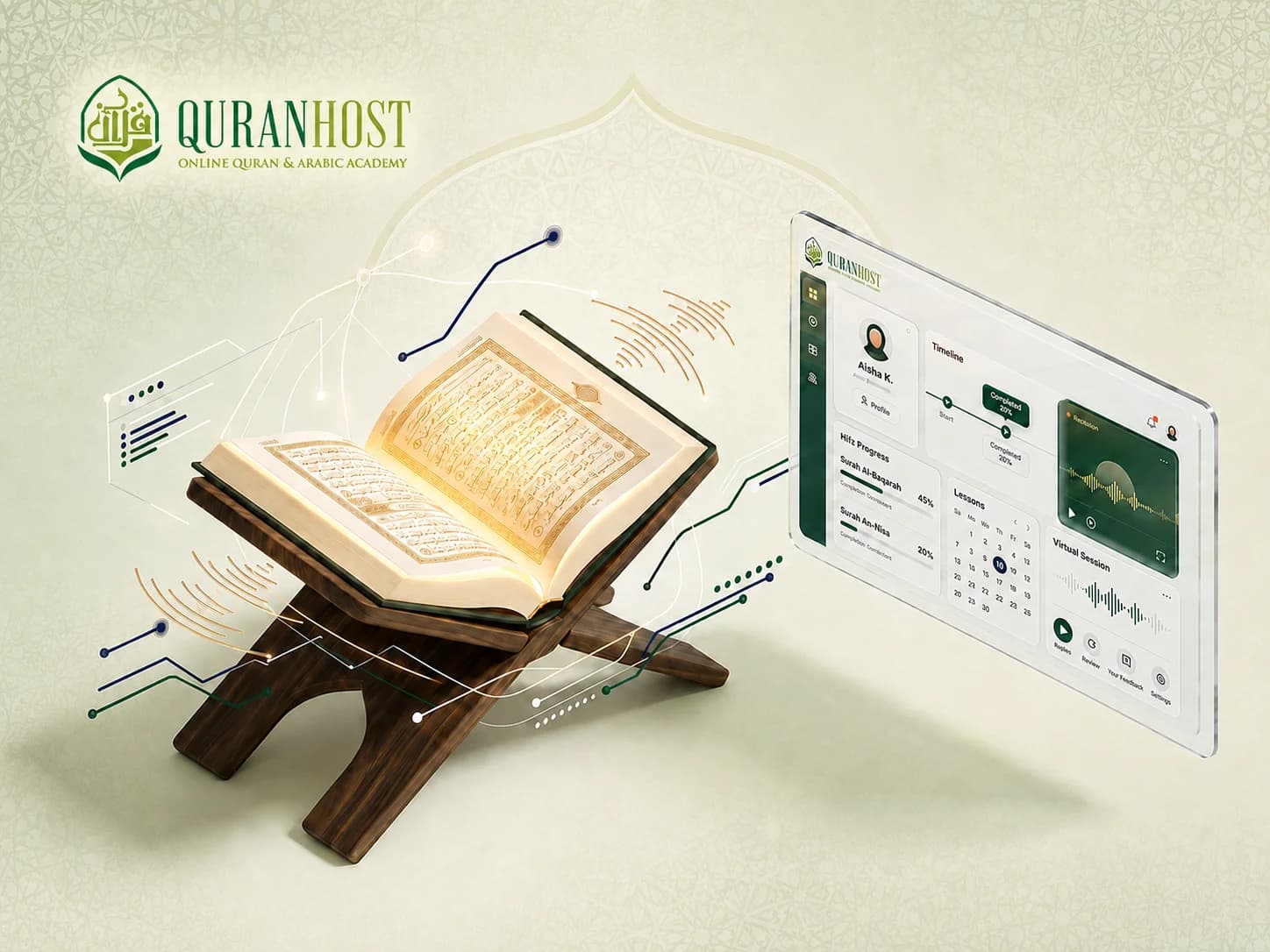
Course at a Glance
Key takeaways
- What it is: live one-to-one Hifz lessons delivered online via Zoom, with a personalized memorization and revision plan.
- Who it's for: children, teenagers, adults, beginners, reverts, and students who have already memorized part of the Quran.
- How it works: every lesson combines new memorization (Sabaq), recent revision (Sabaqi) and older revision (Muraja'ah).
- Tajweed included: pronunciation is corrected while you memorize, so errors are not locked in.
- Goals are flexible: start with Juz Amma or selected Surahs — you are not required to commit to the complete Quran.
- Duration is personal: it depends on age, reading level, daily practice and revision consistency. QuranHost does not promise a fixed timeline.
- Try before enrolling: three free trial classes, including an initial assessment.
Course information
- Course name: Online Quran Memorization Course (Hifz)
- Class format: Live one-to-one, teacher-led
- Suitable ages: Children, teenagers and adults
- Learning level: Beginners who can read Quranic Arabic, through to students continuing existing Hifz
- Teacher options: Qualified male and female Quran tutors
- Class platform: Zoom
- Schedule: Flexible; arranged around international time zones
- Course duration: Personalized — pace is set by the student's level, goal and practice time. No fixed completion period.
- Trial classes: Three free trial classes
- Memorization options: Short Surahs · Selected Surahs · Juz Amma · Selected Juz · Revision of existing memorization · Complete Quran
What Is an Online Quran Memorization Course?
An online Quran memorization course is a structured program in which a student memorizes the Quran under a qualified teacher through live internet lessons rather than in-person classes. The teacher assigns new verses, listens to the student recite from memory, corrects pronunciation and mistakes immediately, and schedules revision so earlier portions are not lost.
How live online lessons work
The student joins a scheduled one-to-one Zoom session with their tutor. The tutor recites the assigned portion correctly, the student repeats and memorizes, and then recites back from memory. Because the class is one-to-one, the tutor can listen closely and correct mistakes as they occur.
Reading the Quran and memorizing it are different skills
Reading (Tilawah) means decoding the text accurately from the Mushaf — the physical copy of the Quran. Memorizing (Hifz) means holding that text in memory and reproducing it without looking. A student may read fluently and still find memorization demanding, because Hifz depends on repetition, retention and revision rather than decoding alone.
Why Tajweed and revision are not optional
Tajweed is the set of rules governing correct Quranic pronunciation. If a student memorizes a word incorrectly, that error is stored in memory and becomes difficult to undo later — which is why QuranHost corrects pronunciation during memorization rather than afterwards. Revision matters for the same reason: memorized material fades without deliberate review, so revision is scheduled into every lesson rather than left to the student.
A teacher creates accountability
Self-study often stalls because nobody checks the work. A tutor sets a specific target, hears the recitation, marks the errors, and adjusts the plan when progress slows or accelerates.
Who Can Join This Hifz Course?
Because every plan is personalized, this course welcomes learners at very different stages. It is a good fit for:
- Children and teenagers
- Adults beginning or resuming Hifz
- Ladies who prefer a female tutor
- Reverts and non-Arabic-speaking Muslims
- Beginners who can already read Quranic Arabic
- Students continuing existing memorization
- Students revising previously memorized portions
To begin memorizing, students should be able to read Quranic Arabic. If you cannot yet recognize the Arabic letters, start with our Noorani Qaida course; if you can read but want greater fluency first, our Quran Reading with Tajweed course is the ideal foundation. Dedicated guidance for children, adults and ladies follows below.
Online Hifz Classes for Kids
Children can begin Hifz with small, age-appropriate targets and short, focused individual lessons that hold their attention. Most young learners start with short Surahs or Juz Amma, guided by patient, encouraging tutors who make each class a positive experience.
Strong revision and retention routines are built in from the start, because children memorize quickly but also forget quickly without regular review. Lessons are scheduled flexibly around school, and parents are encouraged to support short practice between classes. Regular progress monitoring and simple reports keep families informed, and both male and female tutors are available. Our Quran memorization course for kids can also sit alongside our dedicated online Quran classes for kids.
Quran Memorization Course for Adults
Adults can begin or resume Hifz at any suitable stage. Private lessons mean there is no group to keep pace with and no comparison, so you can memorize calmly at your own speed. Schedules are built around work and family, with manageable daily targets and additional revision whenever it is needed.
Whether your goal is a few selected Surahs, Juz Amma, or complete Hifz, your plan is shaped around the practice time you realistically have, and returning or non-Arabic-speaking learners are well supported. For a practical overview of fitting Hifz into a busy routine, read our practical Hifz guide for busy adults. This online Hifz course for adults adapts to you, not the other way around.
Online Quran Memorization for Ladies
Sisters can learn Hifz privately from home with qualified female Quran and Hifz tutors, in a comfortable and respectful environment. Timing is flexible around family, work or study, and each student follows a personalized memorization and revision plan with Tajweed and pronunciation corrected as she memorizes.
Beginners who can already read Quranic Arabic are welcome, and goals range from selected Surahs and Juz Amma to revision or complete Hifz. You can learn more about our female Quran teachers. Our Quran memorization course for ladies is shaped around each student's level and schedule.
MEMORIZATION GOALS & LEVELS
What You Can Memorize
You choose your own memorization goal, and it does not have to be the complete Quran. Students can memorize short Surahs, the popular longer Surahs such as Surah Al-Kahf, Surah Yaseen, Surah Ar-Rahman, Surah Al-Waqi‘ah and Surah Al-Mulk, Juz Amma (Juz 30), Juz 29, selected Juz, previously memorized portions that need revision, or the complete Quran.
Starting with a manageable goal is usually wiser: completing Juz Amma with strong retention builds a real foundation, and goals can be extended once the routine is established. Many students also pair memorization with our Tafseer-ul-Quran course or Arabic language classes. Whatever your goal, your tutor will guide you through the structured levels below.
Selected Surahs or Juz
Memorize short and frequently recited Surahs, Juz Amma (Juz 30) or selected Juz at a comfortable, achievable pace. Ideal for children, beginners and anyone starting their Hifz journey.
Ideal for
- Students who can read Quranic Arabic from the Mushaf
Full Quran (Complete Hifz)
A structured, long-term path to memorizing the entire Quran, balancing new memorization with heavy scheduled revision to protect what has already been memorized.
Ideal for
- Students committed to complete Hifz with consistent daily practice
Revision & Retention
For Huffaz and students who have memorized significant portions and want to strengthen retention through structured Muraja'ah and Tajweed refinement.
Ideal for
- Huffaz and students revising previously memorized portions
OUR METHOD
How the QuranHost Hifz Method Works
Every QuranHost Hifz lesson is built from three parts — new memorization, recent revision and older revision — with Tajweed corrected throughout. This structure is used because memorized material does not stay memorized on its own; it has to be revisited on a schedule.
Sabaq — the new lesson
Sabaq is the new portion assigned for memorization. It is deliberately sized to what the student can memorize and retain, which for a beginner may be two or three lines rather than a full page.
Sabaqi — recent revision
Sabaqi is recently memorized material — typically the work of the past days or weeks — recited again in each lesson. This is the stage where memorization is most fragile, so it is revised most frequently.
Manzil / Muraja'ah — older revision
Manzil (also called Muraja'ah) is the revision of older, previously memorized portions. As a student's memorized total grows, this becomes the largest part of the lesson — and it is what turns short-term memorization into lasting retention.
Every lesson combines new memorization with recent and older revision. For the full explanation of how this system works, see our Quran memorization guide.
Tajweed Correction During Hifz
Students should not memorize pronunciation errors, because an error stored in memory is significantly harder to correct than one caught while reading. For this reason, Tajweed correction runs throughout the memorization process rather than being treated as a separate subject.
As the student recites, tutors correct Makharij (where each letter is articulated), essential Sifaat (letter characteristics), Madd (prolongation), Ghunnah (nasal sound), the Rules of Stopping and Starting, and overall recitation fluency.
This is practical correction applied during Hifz, not a full Tajweed syllabus. Students who want to study the rules of Tajweed in depth can take our Advanced Tajweed course.
How We Monitor Progress and Retention
Consistent monitoring is what turns short-term memorization into lasting retention. In each lesson, tutors assess new memorization, recent revision and older revision, and check retention of previously memorized portions, correcting Tajweed and fluency as the student recites.
Where applicable, progress is supported by monthly tests or progress reports, lesson-history records, and quality monitoring of recorded lessons. Tutors communicate with parents and adjust memorization targets when the evidence suggests a change is needed. We do not promise that a student will never forget or complete Hifz within a fixed time; instead, we focus on steady, well-revised progress.
Male and Female Hifz Tutors
QuranHost provides both male and female Quran tutors, and students or parents may request either when booking. Many families prefer a female tutor for daughters or for adult sisters, and that preference is accommodated.
Tutors are experienced in teaching Hifz and Tajweed, including to children, adults and students who do not speak Arabic. Beyond qualifications, the qualities that matter day to day are patience, clear communication, consistent correction and genuine accountability — a tutor who lets a weak recitation pass is not helping the student.
Teacher–student compatibility matters more than most families expect. A student who feels comfortable will recite openly, make mistakes freely and improve faster. This is a large part of why QuranHost offers three trial classes — and if the match is not right, a different tutor can be arranged.
Meet our qualified Quran tutors to see the experience behind every lesson.
WHY QURANHOST
Why Choose QuranHost for Hifz?
QuranHost combines personalized teaching, structured revision and regular support to address the practical challenges Hifz students face.
Live one-to-one instruction
Every class is private, so the tutor hears every letter and corrects immediately — mistakes are caught in the lesson they occur, not weeks later.
Qualified male and female tutors
Students and parents can request the tutor they are most comfortable with, which matters for many families and makes students more willing to recite openly.
Experienced with non-Arabic speakers
Pronunciation is explained in clear English, so students are not left guessing at sounds their own language does not contain.
Personalized Hifz plans
Targets are built from your assessment, not a fixed syllabus — so the plan matches your level rather than an average student's.
Tajweed correction during memorization
Errors are fixed before they are memorized, saving months of correction later.
Structured Sabaq, Sabaqi and Muraja'ah
Revision is scheduled, not left to willpower — which is what protects what you have already memorized.
Flexible international schedules
Classes are arranged across international time zones, so lessons fit around school, work and family.
Classes for children and adults
Age-appropriate pacing for each, rather than one approach applied to everyone.
Online lessons via Zoom
Familiar, low-friction software — no travel, and lessons continue when you are away from home.
Regular progress monitoring
Tutors track new memorization, revision and retention, so problems are spotted early.
Three free trial classes
You can assess the tutor, the method and the fit before paying anything.
Testimonials
What QuranHost Students Say
Verified reviews from QuranHost students
Alhamdulillah, my Quran recitation was done through QuranHost. With their highly educated and professional teachers I started my Quran in the UK and managed to continue it during my job in various countries — my teacher was always available & flexible in timing and Alhamdulillah I completed my full Quran recitation.

Highly recommended! It has been nearly two years since I commenced my Quran journey with QuranHost. They have really helped me to stay connected with the Quran from foundational studies to memorization. The staff and teachers are helpful and accommodating.

It has been 6 months I study the Quran course, I am very satisfied with the company and the teacher. Everything is very organized and they have really experienced teachers. I am very happy I found them.

How to Get Started
- Book free trial classes. Submit the short form to reserve your no-obligation trial.
- Discuss your goals and current level. Our admissions team learns what you want to memorize and your availability.
- Meet your assigned tutor. Attend your trial lessons and experience the teaching first-hand.
- Receive a personalized memorization and revision plan. Based on an honest assessment of your reading, Tajweed and any existing Hifz.
- Choose a schedule and begin. Start regular one-to-one lessons at times that suit you.
Book your free trial classes, view pricing plans, or browse all courses. You can also read what our students say.
Supporting Learning Resources
This page covers the course and how to enroll. For deeper, step-by-step guidance on how to memorize and revise, our blog goes further:
- Quran memorization methods and revision strategies for students
- Practical Quran memorization guidance for busy adults
These guides are informational; to begin lessons, book your free trial classes above.
Begin Your Hifz Journey with a Personalized Plan
Whether your goal is a handful of Surahs, Juz Amma, or the complete Quran, the starting point is the same: an honest assessment of where you are now. Your first three classes are free, so you can judge the tutor and the method before committing to anything.