


ADVANCED QURAN RECITATION · QIRA’AT SABA ASHRA
Learn Ten Qira’at Online with Qualified Tutors
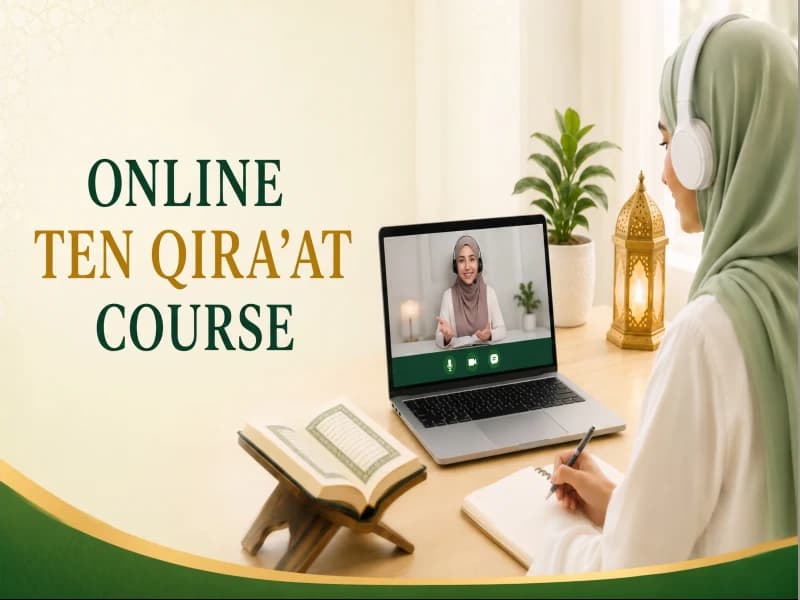
Study the ten canonical Qira’at (Qira’at Saba Ashra) through structured, one-to-one online lessons with a qualified tutor. This advanced program guides fluent reciters and huffaz through the recognized readings of the Quran — their rules (usul), word-by-word differences (farsh), and full recitation (ijra) — with continuous, real-time correction.
- One-to-one live lessons with a qualified Qira’at tutor
- All ten canonical readings — the seven (al-Sab’ah) plus three
- Structured usul, farsh and ijra with immediate correction
- Free trial class — no card required
What Are the Ten Qira’at?
A Qira’ah is a documented, rigorously transmitted way of reciting the Quran, traced through a continuous chain of narration (sanad) back to the Prophet Muhammad (peace be upon him). The ten canonical Qira’at — in Arabic al-Qira’at al-‘Ashr, and often searched as Qira’at Saba Ashra — are the ten readings preserved by the community with sound, unbroken chains.
The readings differ in some points of pronunciation, vowelization (harakat), elongation (madd) and, in places, individual letters. These differences are all part of the authentic transmission of the Quran; they do not change its meaning or contradict one another. Today the most widely recited reading is Hafs ‘an ‘Asim, while Warsh ‘an Nafi’ is common in parts of North and West Africa.
The Ten Canonical Qira’at and Their Transmitters
Each Qira’ah is named after a leading reciter (imam), and each imam’s reading reached us chiefly through two well-known transmitters (rawis) — giving twenty famous riwayat in total. The first seven were popularized by Imam Ibn Mujahid (d. 324 AH); the final three were established as canonical by Imam Ibn al-Jazari (d. 833 AH) in his works al-Nashr and al-Durrah, completing the ten.
| # | Imam (Reciter) | Region | Two Transmitters (Rawis) |
|---|---|---|---|
| 1 | Nafi’ al-Madani | Madinah | Qalun & Warsh |
| 2 | Ibn Kathir al-Makki | Makkah | al-Bazzi & Qunbul |
| 3 | Abu ‘Amr al-Basri | Basra | al-Duri & al-Susi |
| 4 | Ibn ‘Amir al-Shami | Damascus | Hisham & Ibn Dhakwan |
| 5 | ‘Asim al-Kufi | Kufa | Shu‘bah & Hafs |
| 6 | Hamzah al-Kufi | Kufa | Khalaf & Khallad |
| 7 | al-Kisa’i al-Kufi | Kufa | Abu al-Harith & al-Duri |
| 8 | Abu Ja‘far al-Madani | Madinah | Ibn Wardan & Ibn Jammaz |
| 9 | Ya‘qub al-Hadrami | Basra | Ruways & Rawh |
| 10 | Khalaf al-‘Ashir | Baghdad / Kufa | Ishaq & Idris |
Reciters 1–7 are the well-known seven (al-Sab’ah); reciters 8–10 (Abu Ja‘far, Ya‘qub and Khalaf) are the three that complete the ten. Historically the three were sometimes classed as mashhur, but Ibn al-Jazari established all ten as mutawatir (canonical, mass-transmitted) readings.
Qira’at Saba Ashra: Key Terminology
Understanding a few terms makes the study of the ten readings much clearer:
- Qira’ah — a reading attributed to one of the ten imams.
- Riwayah — a reading as transmitted by one of that imam’s two rawis (for example, Hafs ‘an ‘Asim).
- Tariq — a further specific route within a riwayah.
- Usul — the general rules a reciter applies throughout (such as madd, hamz, idgham and imalah).
- Farsh al-Huruf — the specific word-by-word differences between the readings.
- Ijra — reciting the Quran from beginning to end in a given reading under a qualified teacher’s supervision.
Advanced students also distinguish al-‘Ashr al-Sughra (the “minor ten,” studied via al-Shatibiyyah for the seven and al-Durrah for the three) from al-‘Ashr al-Kubra (the “major ten,” studied via Tayyibat al-Nashr, which includes many additional transmission paths, turuq).
The Ten Qira’at Are Not the Seven Ahruf
A common misunderstanding is to equate the Qira’at with the seven ahruf (al-ahruf al-sab‘ah). They are related but not the same thing.
The seven ahruf refer to the modes in which the Quran was revealed. The Prophet (peace be upon him) said the Quran was sent down in seven ahruf, so recite whatever is easy of it (Sahih al-Bukhari 4992; Sahih Muslim 818). Scholars have offered several explanations of what these seven ahruf precisely are.
The Qira’at, by contrast, are the specific, documented reading systems named after later imams and preserved through connected chains of transmission. The “seven” in al-Qira’at al-Sab’ is not the same as the seven ahruf; the ten Qira’at all fall within the authentic, mass-transmitted preservation of the Quran. Your tutor will explain this relationship as part of the course foundations.
Why Choose QuranHost
Why Study the Ten Qira’at with QuranHost
The ten Qira’at is one of the most advanced Quranic sciences, and it is learned by direct oral transmission (talaqqi) — not from books or recordings alone. Here is what our online program offers serious students.
Qualified Qira’at Tutors
Lessons are taught by tutors qualified to teach the ten readings, with strong command of Tajweed and the usul and farsh of each Qira’ah.
One-to-One Lessons
Every session is private and live, so your tutor listens, corrects pronunciation in real time, and adjusts the pace to your level.
Structured Learning
A clear progression — foundations and terminology, then each reciter’s usul, then farsh, then supervised ijra across the Quran.
Male & Female Tutors
Male and female tutors are available for men, women and children, subject to language and scheduling availability.
The Talaqqi Method
You receive the readings the way they have always been transmitted — directly from teacher to student, with careful correction of every detail.
Flexible Scheduling
Book lessons around your work, study and prayer times, across time zones, with a schedule you can keep consistently.
Who Is This Course For? Prerequisites
The ten Qira’at is an advanced course, not a starting point. Before enrolling, a student should already be able to recite the Quran fluently and accurately with correct Tajweed (usually in Hafs ‘an ‘Asim) and have a solid command of the Tajweed rules. Because ijra involves reciting long passages, Hifz (memorization) is strongly recommended and is required by many Qira’at programs.
This course is well suited to:
- Huffaz who want to add the ten readings to their recitation
- Advanced students and teachers of Tajweed
- Imams and Quran teachers seeking deeper mastery
- Serious learners working toward an Ijazah in the ten Qira’at
If you are still building the basics, begin with our Noorani Qaida and Quran reading with Tajweed courses, then strengthen your rules with the advanced Tajweed course and, ideally, complete Hifz before starting the ten Qira’at.
Course Curriculum — What You Will Learn
The curriculum is tailored to your level after an initial assessment, but it generally moves through these stages:
- Foundations & terminology — Qira’ah, riwayah, tariq, mutawatir, and how the Qira’at relate to (and differ from) the seven ahruf.
- Usul of each reading — the general rules each reciter applies (isti‘adhah and basmalah, madd, hamz, idgham, imalah and more) and how they vary between the readings.
- Farsh al-Huruf — the specific word-by-word differences across the ten readings.
- The riwayat — the two well-known transmitters of each imam and what distinguishes them.
- Ijra — reciting the Quran in each reading under your tutor’s direct supervision, applying the rules throughout.
- Progression — from al-‘Ashr al-Sughra (via al-Shatibiyyah and al-Durrah) toward al-‘Ashr al-Kubra (via Tayyibat al-Nashr) for those who continue.
Students who reach the required standard may, with a qualified teacher, pursue an Ijazah in the ten Qira’at — the traditional certificate confirming a connected chain of transmission. Timelines and outcomes depend on your starting level and consistency; we do not promise guaranteed completion times.
Getting Started
How to Get Started with the Ten Qira’at
Begin in three simple steps.
Book a Free Trial & Assessment
Request a free trial class. Your tutor listens to your recitation and reviews your Tajweed and Hifz to confirm readiness and recommend a starting point.
Begin Foundations & Usul
Start with the terminology and the general rules (usul) of the first readings, receiving each detail directly from your tutor.
Progress Through Farsh & Ijra
Apply the readings across the Quran with continuous correction, building toward mastery and, if you wish, an Ijazah pathway.
It only takes a minute to book — and there is no obligation.
Choosing a Qualified Qira’at Tutor
Because the ten Qira’at is transmitted orally, the tutor matters more than any book or app. When choosing a teacher — with us or anywhere — it is reasonable to ask:
- Do they hold an Ijazah in the ten Qira’at with a connected chain (sanad)?
- Which readings and riwayat are they certified to teach?
- How is ijra supervised and corrected?
- Do they have experience teaching students at your level?
Our lessons are delivered by tutors qualified to teach the ten readings so that you receive careful, accurate instruction. Expected outcomes include accurate recitation across the ten readings, a working understanding of the usul and farsh, and the ability to distinguish the riwayat. How quickly you progress depends on your Hifz, your Tajweed, and your practice between lessons — so treat any “guaranteed” timeframe with caution.
Prefer to meet a teacher first? Meet our online Quran teachers or contact us with your goals.
Related Courses
Build the foundations for the ten Qira’at, or continue your Quran studies, with our other one-to-one online courses:
- Noorani Qaida — for beginners learning to read Quranic Arabic.
- Quran Reading with Tajweed — fluent, accurate recitation.
- Advanced Tajweed Course — the rules in depth.
- Hifz — Quran Memorization — a recommended prerequisite.
- Tafseer-ul-Quran — understanding the meanings.
- Arabic Language — read Islamic texts with confidence.
Start Learning the Ten Qira’at Today
Book a free trial and let a qualified tutor assess your level and map your path through the ten readings.