

Why Islamic Studies for Kids Matter
Most Muslim parents want the same thing: that their children grow up knowing what they believe and why, and able to pray, behave and speak as Muslims without having to work it out for themselves later. Between school, work and everything else, few households have the time to teach all of that properly at home.
That is what a structured Islamic studies course is for. This guide sets out what such a course should cover, why the early years matter, and what to look for before you enrol your child.
Many families take Islamic studies alongside Quran lessons. Our starting guide to online Quran classes for kids covers how the reading side of that works.
Why the Early Years Matter Most
Early childhood is when beliefs settle most easily. A child who becomes familiar with the fundamentals young tends to hold them with understanding rather than habit, and questions asked at seven are far easier to answer than questions asked at seventeen.
There is a practical argument too. Religious obligations have to be learned before they can be fulfilled. A child cannot pray properly without being taught wudu and salah, cannot fast Ramadan meaningfully without knowing what fasting is for, and cannot give zakat later in life without understanding it. The learning comes first.
What Every Muslim Child Should Be Taught
There is a core that every Muslim child should be taught, whatever else a course adds around it:
- The articles of faith. Belief in Allah and His oneness, His angels, His revealed books, His prophets and messengers, the Day of Judgement, and the divine decree. The revealed books named in the Quran are the Tawrat given to Musa, the Zabur given to Dawud, the Injil given to Isa, and the Quran given to Muhammad (peace be upon them all).
- The five pillars. The Shahadah, salah, zakat, fasting Ramadan and Hajj: what each one is, and what it asks of a Muslim.
- How to worship in practice. Wudu and salah demonstrated and practised, not only described.
- The life of the Prophet (peace be upon him) and the stories of the earlier Prophets.
- Islamic manners. Truthfulness, honouring parents, respect for elders, and the etiquette of eating, drinking, sleeping and speaking.
- Daily duas and adhkar, with their meanings, so a child understands what they are saying.
- Short surahs, read, memorised and explained.
Children who learn these things grow into them. The values attached to them, truthfulness, patience, forgiveness and keeping one’s word, are the same values that serve a child well in every other part of life.
Benefits of Learning Islam at an Early Age
Learning your belief system early gives your religious principles a foundation to rest on. The benefits parents notice most are not the ones on a syllabus.
Developing a Strong Moral Compass
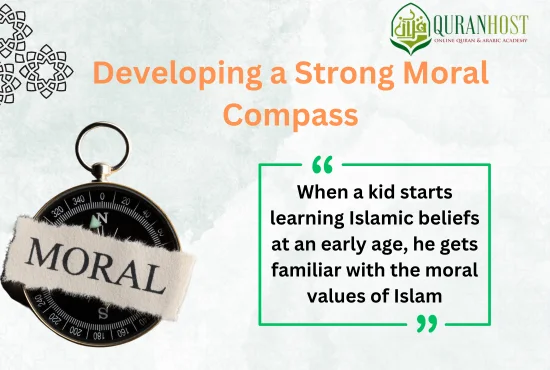
A child taught Islamic values young develops a working sense of right and wrong that they can apply themselves, rather than a list of rules to be followed while someone is watching. Knowing why lying is wrong, and what Islam says about it, shapes character in a way that being told off does not.
Learning About Islamic Culture and History
Alongside belief, a child learns where they come from. Islamic history is rich and varied across different regions of the world, and the Seerah of the Prophet (peace be upon him) gives a child a model they can actually picture. This is what makes the faith feel like theirs rather than something inherited.
Building a Connection to their Faith
A child who understands their beliefs early forms a connection to them that tends to hold. The aim is not a child who can recite definitions, but one who reaches adulthood still praying, still asking questions, and still comfortable in their faith.
How the Course Is Structured
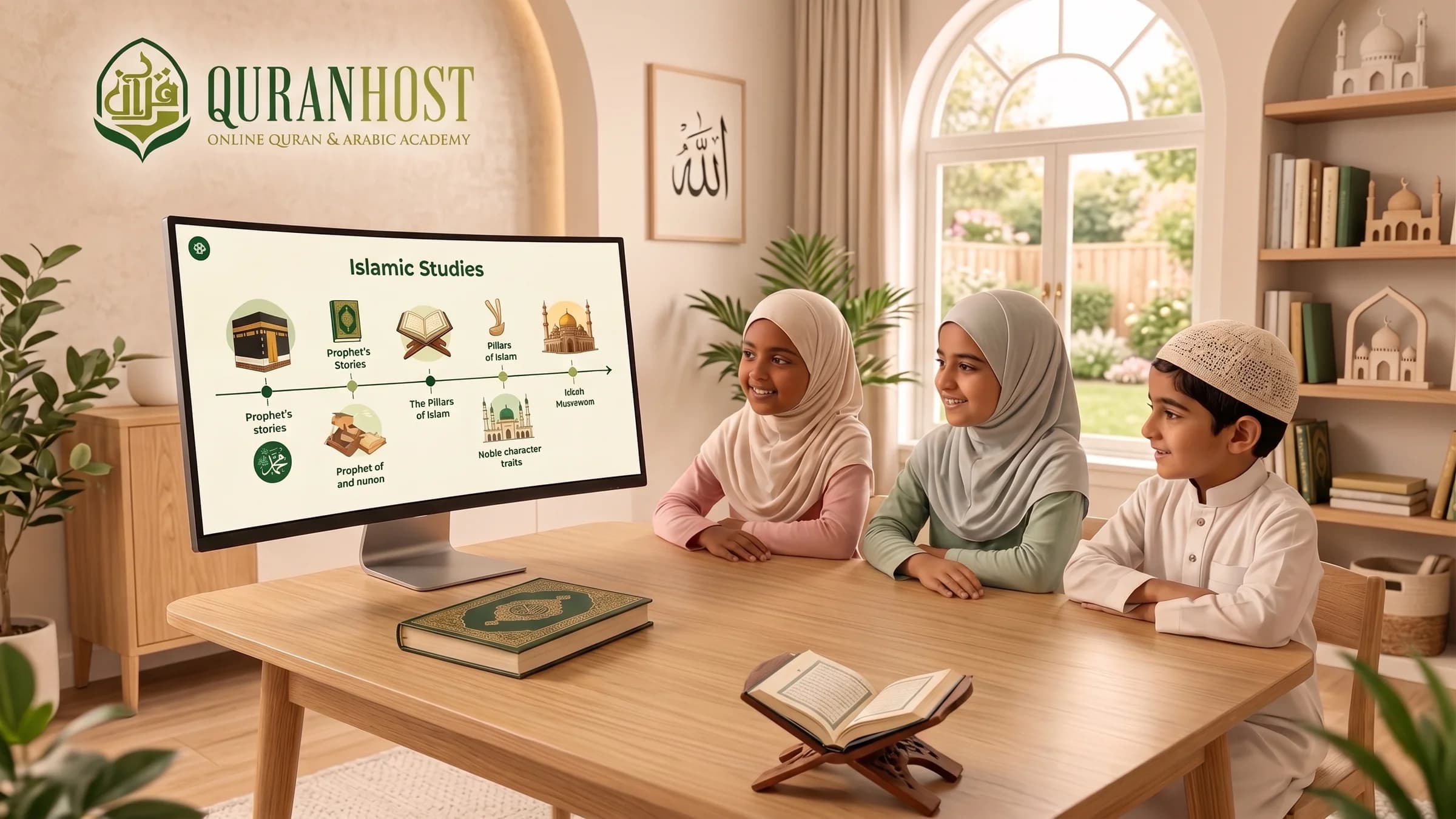
A well-built children’s Islamic studies course moves in stages rather than covering everything at once. QuranHost’s Islamic studies for kids course is taught one to one to children aged 5 to 15, in roughly half-hour lessons, and is organised so that understanding builds step by step:
| Section | What it covers |
|---|---|
| Aqeedah | What Islam and Iman mean, the six articles of faith, and Tawheed, the oneness of Allah. This is belief, and it comes first. |
| The five pillars and daily worship | The Shahadah, salah, zakat, fasting and Hajj, together with taharah and how to perform wudu and salah in practice. |
| Seerah and the Prophets | The life of the Prophet (peace be upon him) and the stories of the earlier Prophets. |
| Islamic manners | Everyday adab: honesty, respect for parents and elders, and the etiquette of eating, drinking, sleeping and speaking. |
| Duas and adhkar | The supplications of daily life, before and after eating, sleeping, waking and travelling, taught with their meanings. |
| Short hadith | A few simple, authentic sayings of the Prophet (peace be upon him) that carry a clear lesson. |
| Short surahs | Reading and memorising surahs such as Al-Fatihah, Al-Ikhlas, Al-Falaq and An-Nas, with their basic meanings. |
A note on where the boundaries sit: aqeedah is belief, while the pillars and worship belong to practice. Courses that blur the two tend to leave children able to list the pillars without understanding what they actually believe.
How the lessons are taught
How the material is taught matters as much as what is in it. At this age that means interactive lessons rather than lectures: asking questions, letting the child guess from hints, colouring, matching and labelling. A child who enjoys the lesson will ask for the next one.
Ask any provider how they teach, not only what they teach. A syllabus that looks thorough on paper is worth little if a seven-year-old sits through it in silence.
What About a Certificate?
Parents often ask whether a certificate comes with the course, so it is worth being precise about what QuranHost currently publishes.
- The Islamic studies for kids course page does not list a completion certificate among its features. If a certificate matters to you, ask the team directly what is issued before you enrol.
- QuranHost’s seasonal summer Islamic courses do list a completion certificate among their course features.
- An Ijazah is a different thing altogether. It is a scholarly licence with a connected Sanad, granted for Quran recitation or memorisation once an authorised teacher is satisfied the required standard has been met. A completion certificate records attendance; an Ijazah records verified mastery within a chain of transmission.
Be wary of any provider, QuranHost included, described as issuing a certificate without the page for that specific course saying so.
Conclusion
A good Islamic studies course gives a child the beliefs, the worship and the manners together, taught at a pace they can follow and in a way they enjoy. Start early, keep it gentle, and choose a course that can show you the order it works through.
QuranHost teaches online Islamic studies for kids aged 5 to 15, one to one with qualified teachers, covering aqeedah, the five pillars, worship, Seerah, manners, duas and short surahs. You can book a free trial class with no card required, or see the full range of courses first.