


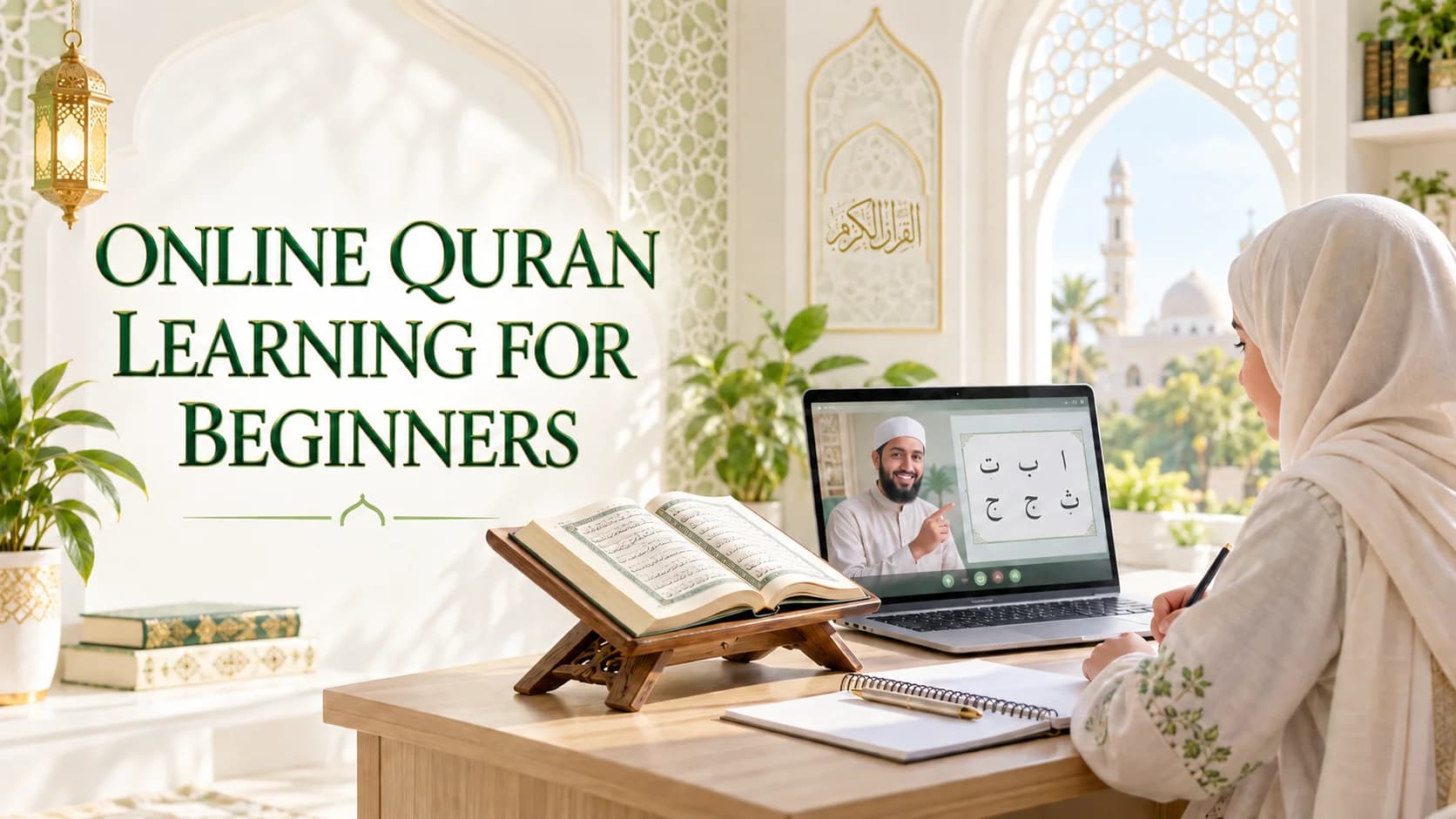
Starting to learn the Quran online can feel confusing when you do not know which course or lesson level is right for you. Some beginners need to start with the Arabic alphabet, while others can already read but need help with fluency, pronunciation or Tajweed.
The right starting point depends on your present ability, not your age or how long you have been away from learning. This guide explains the complete pathway, from recognising Arabic letters and studying Noorani Qaida to reading Quranic verses with greater accuracy and confidence.
Your Complete Quran Learning Path
- Assess your current reading level, identify what you can already recognise, read and pronounce.
- Build your Arabic foundation, learn letters, joined forms, vowels and essential reading signs through Noorani Qaida.
- Begin reading from the Quran, progress from individual words to short verses with teacher correction.
- Apply practical Tajweed, improve Makharij, letter sounds, Madd, Ghunnah and stopping rules gradually.
- Develop fluency through regular practice, revise consistently, correct recurring mistakes and track your progress.
A complete beginner normally starts at Stage 1 or 2. Someone returning after a long break may begin at Stage 3 or 4 after a short assessment.
Stage 1: Take a simple starting-level assessment
Before booking a course, it helps to know your actual level. A good assessment, usually a short session with a teacher, looks at:
- letter recognition
- joined-letter recognition
- the short vowels (Harakat)
- basic reading signs
- reading single words
- reading a full verse
- pronunciation
- fluency
- any Surahs already memorised
- previous learning experience
No two beginners are identical, so no one should be dropped into the same lesson by default. A few minutes of assessment saves weeks of studying at the wrong level.
Stage 2: Learn the Arabic letters and joined forms
The foundation of Quran reading is the Arabic script. Early on you will work on:
- identifying each letter
- recognising how a letter changes shape at the start, middle and end of a word
- joining letters together
- the short vowels, Sukoon, Tanween and Shaddah
- simple reading practice
The classic tool for this stage is Noorani Qaida, a step-by-step primer that builds the letters and sounds in order. It suits children and adult beginners equally, there is nothing childish about starting with strong foundations. For what accurate Arabic pronunciation actually requires, see how to read the Quran in Arabic correctly.
Stage 3: Move from Qaida to Quran reading
Once the letters and vowels are secure, you move from exercises to reading directly from the Mushaf. This transition works best when you:
- recognise familiar letter patterns as you go
- read complete words, then short verses
- resist the urge to read too fast
- have mistakes corrected straight away
- build fluency gradually, with regular practice
A teacher supervising your recitation makes a real difference here. You can see how this is taught in Quran reading with Tajweed, where reading and pronunciation develop together.
Stage 4: Learn practical Tajweed gradually
Tajweed simply means reciting each letter correctly, and it is best learned while you read rather than saved for later. You do not need heavy theory at the start, just a few practical points:
- Makharij, where each letter’s sound comes from
- giving each letter its correct sound
- Madd, lengthening certain letters
- Ghunnah, the nasal sound
- pausing in the right places
That is enough to build accurate habits. Learners who later want the rules in depth can move on to a dedicated Tajweed course. Keep the distinction in mind: reading with practical Tajweed comes first; studying the full rules is a later, separate step.
Stage 5: Build a realistic practice routine
Progress comes from steady practice between lessons, not marathon sessions. A routine that works for most beginners:
- short, regular practice beats occasional long sessions
- review the previous lesson first
- read aloud, not silently
- listen to a good reciter and repeat
- fix one recurring mistake at a time
- practise between your live lessons
- keep a simple note of progress
- avoid long gaps, consistency matters more than intensity
Ten focused minutes a day usually beats one long session a week.
Beginner Guidance for Different Learners
Children
Children learn well online when lessons suit their age. Helpful habits:
- keep lessons short and paced for the child
- encourage rather than pressure them
- use interactive practice and gentle repetition
- revise little and often
- praise genuine effort and progress
- stay visible during online lessons so you can support them
The right lesson length varies from child to child, so watch their attention rather than the clock. See Quran classes for children for how younger beginners are taught.
Adults
Many adults worry they have left it too late. They have not. Adults often make steady progress because they are motivated and disciplined. If you are starting or restarting as an adult:
- it is completely normal to begin with Qaida or a reading assessment
- learn at a flexible pace that fits work and family
- be patient while correcting long-held pronunciation habits
- set small, achievable goals
- practise consistently, even briefly
There is no age limit on learning the Quran, and no need for embarrassment about beginning with the basics.
Reverts and new Muslims
If you have recently embraced Islam, you do not need to learn everything at once. A gentle starting order works best:
- the essential recitation you need for Salah
- Surah Al-Fatihah
- a few short Surahs
- basic, correct pronunciation
- gradual letter and reading instruction alongside
- foundational Islamic knowledge as you go
Take it step by step rather than attempting a full curriculum from day one. Broader foundations are covered in online Islamic teaching.
What Equipment Do You Need?
Very little, in fact. To learn online you need:
- a laptop, tablet or another suitable device
- a stable internet connection
- a microphone and speakers, or a headset
- a Quran or Qaida to follow
- a quiet space to focus
- the current class platform, such as Zoom
- a notebook for corrections and practice
Clear audio matters most, so the teacher can hear each letter and correct it.
What Progress Should You Expect?
Progress depends on your starting level, age, how often you attend and how much you practise between lessons, so timelines vary from person to person. Rather than a fixed number of days, think in stages:
- recognising the letters
- reading joined letters
- reading whole words
- reading short verses
- more fluent, supervised recitation
- applying practical Tajweed more confidently
Everyone moves through these at their own speed, steady progress is the goal, not a race.
Common beginner mistakes to avoid
A few habits slow beginners down. Try to avoid:
- reading too quickly
- skipping the foundational letter practice
- memorising incorrect pronunciation
- practising with no one to correct you
- taking long breaks between lessons
- comparing your progress with others
- jumping into advanced Tajweed theory too early
- expecting instant fluency
- relying only on recorded videos with no feedback
- signing up for too many courses at once
How live one-to-one lessons can help
For beginners, live one-to-one lessons offer some real advantages:
- your mistakes are corrected individually
- the pace is set around you, not a class
- you can ask questions freely
- practice stays focused on your gaps
- you get regular feedback on progress
- scheduling is flexible
This does not mean online learning is automatically better than a mosque, a madrasah or a good group class, each has its place, and the right choice depends on your circumstances. If you also want to weigh up providers, see our guide on how to evaluate online Quran classes.
How QuranHost supports beginners
QuranHost teaches beginners through live, one-to-one online lessons for both children and adults, with male and female tutors. A teacher assesses your starting level, recommends a suitable course, and arranges a schedule that fits your week. You can browse everything on the courses page, meet the online Quran teachers (including female teachers), see plans on the pricing page, or book a free trial to get a recommendation before you commit.
Conclusion
Learning the Quran as a beginner is far more achievable than it first looks. Start at your actual level, build accurate foundations one step at a time, practise a little each day, and let a teacher correct you along the way. Do that consistently and reading will come.
When you are ready, request a beginner assessment or a free trial, and start from exactly where you are today.
From here, the full step-by-step method sets out the whole path. If paying for lessons is the barrier right now, the free ways to start learning are worth knowing before you commit. Some beginners prefer to work on their own at first, and if you want a defined finish line, a sixty-day reading plan gives you one.