


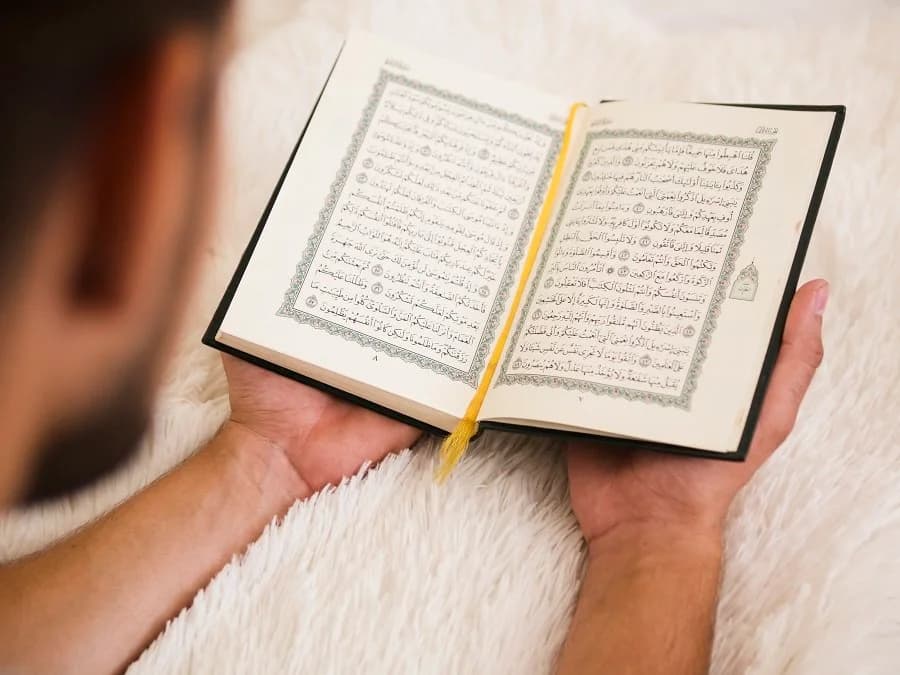
If you do not speak Arabic, you can still understand the Quran word by word. The most reliable method has four parts: read with a word-by-word (interlinear) translation next to a full translation, learn the most frequent Quranic words and their roots, pick up a few basic grammar patterns, and check what you think a verse means against tafsir and a qualified teacher. Fifteen minutes a day with a short surah is a good way to start.
Word-by-Word Translation, Translation, Tafsir and Reflection
These four are often mixed up, but each does a different job:
- Word-by-word translation gives the literal meaning of each Arabic word on its own. The English often reads awkwardly.
- A full translation joins those meanings into readable sentences.
- Tafsir is scholarly explanation: what the verse means, how other verses and the Sunnah clarify it, and the context in which it was revealed. Tafsir Ibn Kathir is a well-known classical example.
- Reflection (tadabbur) is your own thoughtful engagement with the meaning and how it applies to your life. It builds on translation and tafsir; it does not replace them.
Turn On a Word-by-Word Translation
The easiest place to begin is the free website Quran.com. Open Settings, go to the Word By Word section, and choose a translation, a transliteration, or both. You can show them directly under each Arabic word, or as a tooltip when you hover over or click a word. You can also hear the recitation of individual words.
Keep a full translation switched on too: the word-by-word line shows how the verse is built, and the full translation shows how it reads.
Try It on One Verse
Here is a verse that describes the very purpose of studying the Quran closely:
كِتَـٰبٌ أَنزَلْنَـٰهُ إِلَيْكَ مُبَـٰرَكٌ لِّيَدَّبَّرُوٓا۟ ءَايَـٰتِهِۦ وَلِيَتَذَكَّرَ أُو۟لُوا۟ ٱلْأَلْبَـٰبِ“[This is] a blessed Book which We have revealed to you, [O Muḥammad], that they might reflect upon its verses and that those of understanding would be reminded.”
Quran 38:29, translation: Sahih International.
This verse is addressed first to the Prophet ﷺ: it describes the Book revealed to him and states why it was sent down, so that people would reflect on its verses and those of understanding would take heed. Many readers take from it a personal lesson: the Quran is meant to be understood and pondered, not only recited.
Broken into words, using the word-by-word glosses shown on Quran.com, it looks like this:
| Arabic (transliteration) | Word-by-word meaning |
|---|---|
| كِتَـٰبٌ kitābun | (This is) a Book |
| أَنزَلْنَـٰهُ anzalnāhu | We have revealed it |
| إِلَيْكَ ilayka | to you |
| مُبَـٰرَكٌ mubārakun | blessed |
| لِّيَدَّبَّرُوٓا۟ liyaddabbarū | that they may ponder |
| ءَايَـٰتِهِۦ āyātihi | (over) its Verses |
| وَلِيَتَذَكَّرَ waliyatadhakkara | and may be reminded |
| أُو۟لُوا۟ ٱلْأَلْبَـٰبِ ulū l-albābi (two-word phrase) | those of understanding |
Notice that one Arabic word can carry several English words: anzalnāhu alone means "We have revealed it." This is where roots and grammar start to matter.
Learn Roots: One Root, Many Related Words
Most Arabic words are built from a root of three consonants that carries a core meaning. Know the root, and you can often recognize a whole family of words.
Take the root k-t-b, linked to writing. According to the Quranic Arabic Corpus, it appears 319 times in the Quran, including 260 times as the noun kitāb (book), 49 times as the verb kataba (to write, to prescribe), six times as kātib (writer, scribe) and once as maktūb (written). The first word of the verse above, kitābun, is from this root.
The same verse holds another useful link: liyaddabbarū (that they may ponder) comes from the root d-b-r, the same root as tadabbur, reflection.
To explore roots yourself, use the Quranic Arabic Corpus. Click any word in a verse to see its root and grammar, or use its Quran Dictionary to see where a root occurs. The corpus itself cautions that an Arabic word may have a range of meanings depending on context.
Learn the Most Frequent Words First
A few hundred frequent words make up a large share of the Quran's text: particles like wa (and), fī (in) and min (from), pronouns, and recurring words such as rabb (Lord), qāla (he said) and āmana (he believed). Take your vocabulary from the Quran itself rather than general Arabic lists, so every word you learn keeps reappearing in your reading.
Pick Up a Few Basic Grammar Patterns
Arabic attaches small pieces to the start and end of words, and a handful of these unlock a lot of meaning. In the verse above:
- Endings for pronouns: -nā (we) and -hu (it) in anzalnāhu; -ka (you) in ilayka; -hi (its) in āyātihi.
- Prefixes: wa- (and) and li- (so that) in waliyatadhakkara, "and so that they may be reminded."
Learning these patterns, plus basic verb forms and plurals, means you lean less on translation. Grammar does not replace tafsir, though: knowing what each word means is not the same as knowing how scholars understood the verse and its context.
Pronouncing each word correctly is a separate skill again. That is Tajweed, the rules of recitation, worth learning alongside meaning but not to be confused with it.
Check Your Understanding With Tafsir and a Teacher
Word-by-word study can lead you to a meaning that sounds right but is not. Before you settle on how you understand a verse, read what a recognized tafsir says about it (Quran.com offers several), and ask a qualified teacher when something is unclear. Islamic guidance comes from the Quran and the Sunnah together, and many verses are explained by the Prophet's ﷺ own words and practice.
A Suggested 15-Minute Starting Routine
Here is one way to start. Adjust the times and steps to suit you.
- Pick a short surah, ideally one you already recite in prayer. Our guide to the last ten surahs of the Quran gives the Arabic, the translation and a short explanation of each.
- Read word by word (5 minutes). Take two or three verses, say each word aloud and read its meaning.
- Read the full translation (2 minutes) to see how the words join up.
- Note new words (3 minutes) with their meanings, and look up the root of one or two.
- Revise (5 minutes). Go over yesterday's words before moving on.
Once a week, read the tafsir of the verses you studied.
If It Feels Hard, Keep Going
Many learners feel slow at first. The Prophet ﷺ said that the one who is proficient in the Quran is with the noble, upright, recording angels, and continued:
وَالَّذِي يَقْرَأُ الْقُرْآنَ وَيَتَتَعْتَعُ فِيهِ وَهُوَ عَلَيْهِ شَاقٌّ لَهُ أَجْرَانِ“and he who falters in it, and finds it difficult for him, will have two rewards.”
Sahih Muslim 798, narrated by Aishah.
This hadith is about reciting the Quran when it is hard for you; it does not speak specifically about learning vocabulary or grammar. It is still a reminder of how much the effort to engage with the Quran is valued.
If you would like a structured path through Quranic vocabulary and grammar, our Quranic Arabic course offers live one-to-one online classes, and you can book a free trial class first.