


If you believe that there is only one God and that Muhammad (peace be upon him) is His Messenger, you become a Muslim by saying the Shahada, the declaration of faith. That is the requirement. It takes one sentence and a sincere heart.
You do not have to visit a mosque first, find an imam, bring witnesses, speak Arabic, change your name, pay anything or finish a course. Several of those things are helpful afterwards, and this guide explains them, but none of them is what makes you a Muslim.
Below you will find what accepting Islam actually means, the Shahada in Arabic with a transliteration and translation, a clear line between what is genuinely required and what is simply recommended, and the gentle first steps that follow.
On this page
- What accepting Islam means
- Sincere belief and free choice
- The Shahada: the words and their meaning
- Do you need a mosque, an imam or witnesses?
- Accept Islam online with QuranHost
- What happens straight after the Shahada
- Arabic, names and certificates
- What comes next
- Learning support at QuranHost
- Sources and further reading
What accepting Islam means
The Arabic word Islam means willingly submitting yourself to God, who is called Allah in Arabic. The same root carries the sense of peace that comes from that submission. A Muslim is simply a person who makes it.
Muslims believe God sent prophets to every people, and that they carried one message: worship God alone and live justly. The Quran names many of them, including Noah, Abraham, Moses and Jesus, peace be upon them all, and teaches that Muhammad (peace be upon him) was the last in that line.
إِنَّ ٱلدِّينَ عِندَ ٱللَّهِ ٱلْإِسْلَٰمُInna ad-dina 'inda Allahi al-Islam
“Indeed, the religion in the sight of Allah is Islam.” (Quran 3:19)
If you are coming from another faith, you are not being asked to hold your past in contempt. Much of what you already value, honesty, care for your parents, kindness towards people in need, is asked of you in Islam too. What changes is who you worship and whose guidance you follow.
There is also a mercy here that reassures a great many people. The Prophet (peace be upon him) told 'Amr ibn al-'As that “Islam demolishes what came before it” (Sahih Muslim 121). Whatever is behind you, accepting Islam draws a line under it. You do not owe missed prayers or fasts from before the day you became Muslim.
Sincere belief and free choice
Two things have to be true for the Shahada to mean anything. You have to believe it, and you have to say it freely.
Islam does not accept a forced conversion. The Quran is direct about it:
لَا إِكْرَاهَ فِي ٱلدِّينِLa ikraha fi ad-din
“There shall be no compulsion in religion.” (Quran 2:256)
Nobody can accept Islam on your behalf, and nobody should press you into it. If you are still reading and still thinking, that is perfectly fine. Take the time you need.
Intention carries as much weight as the words. The Prophet (peace be upon him) said, “Actions are but by intentions, and every person shall have only what they intended” (Sahih al-Bukhari 1). Saying the Shahada without believing it changes nothing. Saying it sincerely changes everything.
The Shahada: the words and their meaning
The Shahada is one sentence in two halves. This is the short form:
أَشْهَدُ أَنْ لَا إِلَٰهَ إِلَّا اللَّهُ وَأَشْهَدُ أَنَّ مُحَمَّدًا رَسُولُ اللَّهِTransliteration: Ash-hadu an la ilaha illa Allah, wa ash-hadu anna Muhammadan rasulu Allah.
Meaning: “I bear witness that there is no god but Allah, and I bear witness that Muhammad is the Messenger of Allah.”
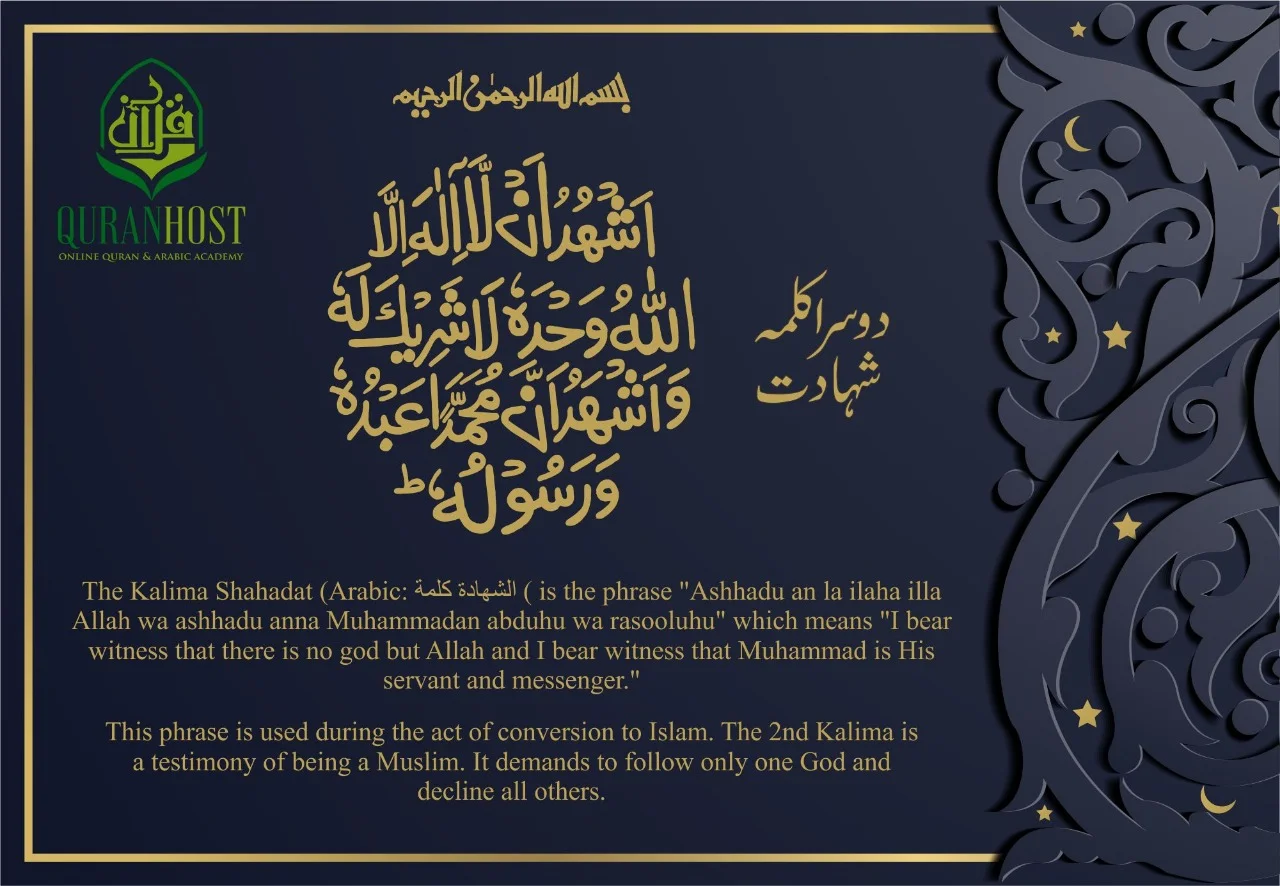
A slightly fuller wording is also widely used. It is known as the second kalima, and it adds that God is one without partner and that Muhammad is God's servant as well as His Messenger:
أَشْهَدُ أَنْ لَا إِلَٰهَ إِلَّا اللَّهُ وَحْدَهُ لَا شَرِيكَ لَهُ وَأَشْهَدُ أَنَّ مُحَمَّدًا عَبْدُهُ وَرَسُولُهُTransliteration: Ash-hadu an la ilaha illa Allah, wahdahu la sharika lah, wa ash-hadu anna Muhammadan 'abduhu wa rasuluh.
Meaning: “I bear witness that there is no god but Allah, alone, without partner, and I bear witness that Muhammad is His servant and His Messenger.”
Either wording is accepted. Use whichever you find easier to say.
Say it aloud if you are able to, understanding the words and believing them. That is what makes you a Muslim.
You may say it on your own, at home, at any hour. There is no required place, no required clothing and no ceremony that has to happen first.
If the Arabic is difficult, that is not a barrier. Scholars are agreed that someone who does not know Arabic may declare it in their own language and is a Muslim from that moment, and that imperfect pronunciation does not invalidate it (IslamWeb, fatwa 330400). Say the meaning in the language you think in, and learn the Arabic at your own pace.
Do you need a mosque, an imam or witnesses?
No. None of these is a condition for entering Islam.
Islam Question and Answer states plainly that it is not essential to take the Shahada before witnesses, because this is a matter between a person and their Lord (fatwa 11936). SeekersGuidance gives the same ruling: “Saying the shahada does not require witnesses to be valid. If one declares the testimony of faith in any way or form, even alone, that is enough for them to be considered a Muslim” (SeekersGuidance).
So why do mosques and Islamic centres offer to witness it and issue a certificate? Because a written record is useful for practical matters later, such as registering an Islamic marriage, applying for a Hajj or Umrah visa, or questions of inheritance in some countries. It is documentation, not a religious requirement.
There is a human reason to go as well. Saying the Shahada among people who will then know you, answer your questions and invite you round is genuine support, and it is hard to replace. If you would like that, look for a mosque or Islamic centre near you when you feel ready. If you would rather not, or if it would not be safe for you at the moment, your Shahada still stands.
Accept Islam Online with QuranHost
If you would like someone to talk to while you take this step, QuranHost provides online assistance for people who wish to accept Islam and take their Shahada. You can contact the team for guidance and support with the declaration itself and with what follows it.
This is optional. Contacting QuranHost, registering or buying lessons is not a condition for becoming a Muslim. As set out above, sincere belief and the declaration of faith are what make a person Muslim, made freely and without compulsion, and you may say the Shahada on your own wherever you are. A local mosque or Islamic centre remains a good option too, particularly if you would like to meet people near you.
What happens straight after the Shahada
Three things often get blurred together. Separating them makes the first week much less daunting.
1. Entering Islam. This is the Shahada, and it is immediate. The moment you believe it and declare it, you are a Muslim.
2. Purification. Many new Muslims then perform a full bath, called ghusl. Scholars differ on its status: the Maliki school and most Hanbalis hold it obligatory for someone entering Islam, while the Hanafi and Shafi'i schools, and some Hanbali scholars, hold it strongly recommended rather than obligatory (IslamWeb, fatwa 11140). Both positions agree on the part that matters most to you: it is not a condition for your conversion to be valid, and it comes after the Shahada rather than before it.
3. Ongoing practice. Prayer, fasting in Ramadan, zakat and Hajj are the four pillars that follow the Shahada. They are obligations you grow into, each with its own conditions and allowances. They are not entry requirements, and nobody expects you to arrive knowing them.
In practice, most people's first step after the Shahada is learning wudu, the ablution before prayer, and then the prayer itself. Our guide to how to pray in Islam walks through the movements one at a time.
Arabic, names and certificates
Do you need to know Arabic?
No. Most Muslims in the world are not Arabic speakers. You will want to learn the short Arabic passages used in prayer over time, and many people find that easier than they expected because the same few passages repeat every day. Until then, you can begin with what you can manage and add as you learn.
Reading the Quran in Arabic is a separate skill, usually started with the Arabic letters and their sounds. Our guide on Quran learning for beginners explains how that normally starts.
Do you have to change your name?
No, and there is no particular merit in doing so. Two of the best known Companions of the Prophet (peace be upon him) were converts who kept the names they came with, Salman al-Farisi and Suhayb al-Rumi.
The exception is narrow. A name is changed when its meaning conflicts with belief in one God, for example a name meaning “servant of” someone other than God, or a name with an offensive meaning (IslamQA 23273, Dar al-Ifta, Egypt). Outside that, keeping your name is entirely normal. Some converts choose an additional Arabic name because they like it, which is a personal choice and not a religious instruction.
Do you need a certificate?
Not for your Shahada to count. A certificate from a mosque or Islamic centre is an administrative document, and it is worth obtaining if you expect to need proof for an Islamic marriage, a Hajj or Umrah visa, or a legal matter in a country that records religion.
If none of that applies to you now, you can always arrange it later.
What comes next
The days after the Shahada are for learning slowly, not for changing everything at once. In practice that usually means purification and prayer first, then reading, then the rest as it comes.
We have written that up separately so this page stays focused on the decision itself. See A Guide for New Muslims: First Steps After Shahada for what to learn first, how to find trustworthy guidance, how to handle family and cultural expectations, and a manageable first month.
If you would like the theology behind the declaration in more depth, our article on the Shahada as the first pillar of Islam covers it.
Learning support at QuranHost
Once you have taken your Shahada, the usual next question is where to learn. Lessons are separate from the Shahada support described above, and none of them is required in order to become or remain a Muslim.
QuranHost is an online Quran and Arabic academy offering one-to-one lessons. Two things are worth stating precisely:
- A free trial class. Any new learner can book one at no charge and with no card details, subject to tutor scheduling. See Book a Free Trial Class.
- Sponsored places, which are limited. QuranHost funds a limited number of fully or partially sponsored places for learners who cannot afford tuition, and new Muslims are one of the priority groups. Places depend on eligibility, availability and attendance, and they are applied for rather than granted automatically. The terms are set out on Free Online Quran Classes.
If you have questions about Quran lessons or would like to enquire about a sponsored place, please contact our team.
Frequently Asked Questions
Short answers to the questions people ask most often before accepting Islam.
Sources and further reading
The religious points on this page were checked against the following published sources. They are linked so you can read the full answers rather than take ours on trust. This page has not been reviewed by a named scholar; where scholars differ, we have said so.
- Quran 3:19 and Quran 2:256, Quran.com
- Sahih al-Bukhari 1 and Sahih Muslim 121, Sunnah.com
- Witnesses are not essential to enter Islam, Islam Question and Answer
- Does taking Shahada require witnesses?, SeekersGuidance
- Ruling on ghusl for those embracing Islam, IslamWeb
- Mistakes in pronouncing the Shahada, IslamWeb
- How important is it for a new Muslim to change his name?, Islam Question and Answer
- Should a new convert change their name?, Dar al-Ifta al-Misriyyah