


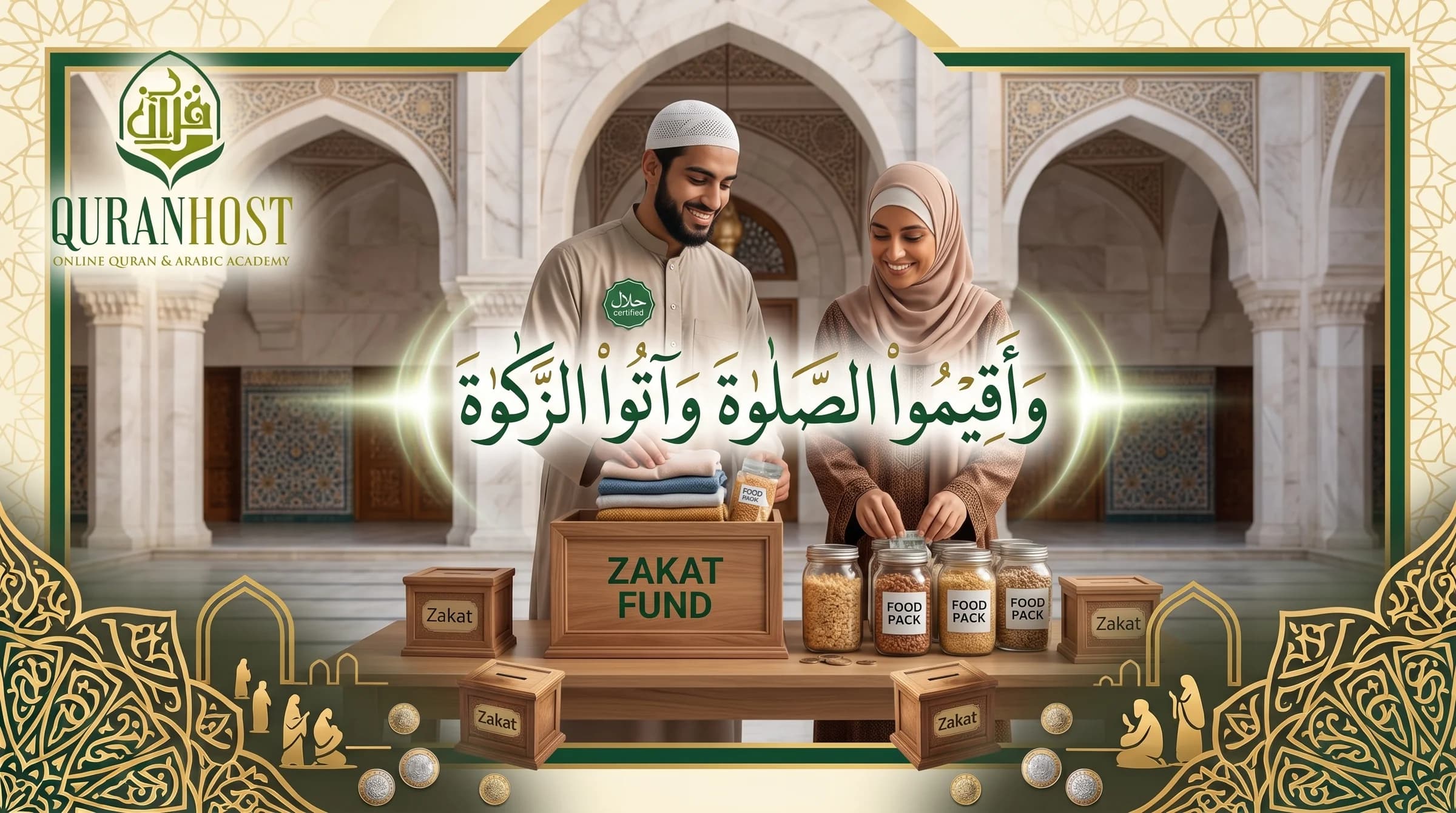
Zakat is the third pillar of Islam: an obligatory annual transfer of a fixed share of qualifying wealth to people the Quran names as its recipients. It is not charity in the ordinary sense. It is a duty, owed at a set rate, on a set threshold, at a set time.
The word itself carries the point. The Arabic root z-k-w means both purification and growth, and the Quran uses that root when it instructs the Prophet (peace be upon him) to take from people's wealth in order to purify them (Quran 9:103). Zakat is presented as something that cleans the wealth it is taken from and the person it is taken from, and that causes what remains to grow rather than shrink.
This guide explains where Zakat sits among the pillars and why, what makes it so important spiritually and socially, who has to pay it, and who may receive it.
Zakat as the Third Pillar of Islam
The ordering comes from the Prophet (peace be upon him) himself. Ibn Umar (RA) narrated that Islam is built on five: the testimony that there is no god but Allah and that Muhammad is His Messenger, establishing the prayer, giving Zakat, the pilgrimage, and fasting Ramadan (Sahih al-Bukhari 8). Zakat is named third, directly after the declaration of faith and the prayer, and it is third in every standard listing of the pillars.
That position is not arbitrary. The first pillar settles what a person believes. The second turns that belief into a daily discipline of the body. The third is where it reaches the bank account.
Read in sequence, the pillars move outward: from conviction, to personal worship, to obligation towards other people. Zakat is the first pillar whose effect lands on somebody else. It is the point at which faith stops being private.
The Quran reflects this by pairing prayer and Zakat again and again, treating them as two halves of one commitment rather than separate virtues. “Establish prayer, and pay alms-tax” (Quran 2:110) is one of dozens of places where the two appear in the same breath, as in “establish prayer, pay alms-tax, and bow down with those who bow down” (Quran 2:43). A person who prays but withholds Zakat has taken up half of what the verse asks.
For the pillar that precedes it, see our guide to how to pray in Islam.
Why Is Zakat So Important in Islam?
Its importance works on two levels at once, and Islamic sources treat them as inseparable.
Spiritual: it purifies the owner as much as the wealth
The instruction in Quran 9:103 is to take charity from their wealth “to purify and bless them”, and the pronoun is worth noticing: the purification is of them, the people, not only of the money.
What it purifies them of is a specific disease. Wealth held tightly breeds attachment, and attachment breeds the assumption that what you have is yours because you earned it. Zakat interrupts that annually. Handing over a fixed share, calculated rather than chosen, to people you may never meet, is a practical correction to the idea that ownership is absolute. In Islamic terms the wealth was always God's; Zakat is the acknowledgement of that, made in cash.
It also protects the giver from the quiet corrosion of miserliness. The amount is fixed precisely so that generosity is not left to mood. A person who would never feel moved to give still gives.
Social: it moves wealth rather than merely praising generosity
Zakat is a redistribution mechanism with named beneficiaries, a fixed rate and an annual cycle. It does not depend on anyone feeling charitable in a given year.
Its social effect is structural. Because it falls on accumulated wealth rather than income, it presses against hoarding: money left idle is charged year after year, while money put to productive use has a chance to outgrow the charge. Because the recipients are defined, it reaches the poor, the indebted and the stranded rather than whichever cause is most visible.
And because it is an entitlement rather than a favour, it changes the relationship between giver and receiver. The Quran calls these payments a right belonging to the recipients, ordained by God. The poor person is not receiving someone's kindness; they are receiving what was assigned to them.
Spiritual and Social Importance of Zakat
Zakat differs from voluntary charity in one decisive way: it is an obligation with a fixed rate, a fixed threshold and named recipients, not a gesture left to the giver's mood. Sadaqah is encouraged at any amount and at any time. Zakat is owed.
That obligation is what makes it work economically. Because a fixed share of qualifying wealth moves every lunar year, wealth circulates through every segment of society instead of accumulating at the top. Where the needs of the poor go unmet while a small segment grows steadily richer, resentment and crime follow. Islam treats the care of those in need as a shared responsibility of the whole community, and Zakat is the mechanism that discharges it.
The spiritual and the social sides are one act, not two. The payment that purifies the owner is the same payment that reaches the recipient.
Who Is Obligated to Pay Zakat?
Zakat is due from a Muslim who is an adult of sound mind and owns qualifying wealth above the threshold for a full lunar year (Islam Question and Answer on the conditions of Zakat). Three conditions do the work:
- Nisab, the threshold. The minimum is the value of 87.48 grams of gold or 612.36 grams of silver. Since metal prices move daily, no currency figure stays valid, so take the current price per gram and multiply. Most people are assessed against the silver figure, which is lower and therefore brings more payers into scope.
- Hawl, the holding period. The wealth must remain at or above the nisab for one full lunar year. This is what separates Zakat from most other obligations: a windfall received last month is not yet liable.
- The rate. 2.5 per cent of qualifying wealth, assessed once the year completes. Qualifying wealth means cash and bank balances, gold and silver, business stock, investments and receivable debts. Personal use assets such as your home, car, furniture and clothing are not counted, and debts that are due are deducted.
Agricultural produce and livestock follow their own rates and rules rather than the 2.5 per cent figure, and Zakat al-Fitr is a separate, smaller obligation tied to the end of Ramadan, which we cover in who is eligible to pay Zakat al-Fitr.
Who may receive Zakat: the eight categories
The recipients are fixed by the Quran, not by the payer's preference:
إِنَّمَا ٱلصَّدَقَٰتُ لِلْفُقَرَآءِ وَٱلْمَسَٰكِينِ وَٱلْعَٰمِلِينَ عَلَيْهَا وَٱلْمُؤَلَّفَةِ قُلُوبُهُمْ وَفِى ٱلرِّقَابِ وَٱلْغَٰرِمِينَ وَفِى سَبِيلِ ٱللَّهِ وَٱبْنِ ٱلسَّبِيلِ“Alms-tax is only for the poor and the needy, for those employed to administer it, for those whose hearts are attracted to the faith, for freeing slaves, for those in debt, for Allah's cause, and for needy travellers.” (Quran 9:60)
Those eight are: the poor; the needy; those employed to collect and administer it; those whose hearts are being reconciled; freeing people from bondage; the debt-burdened; in the cause of God; and the traveller cut off from their means. Scholars differ on how some categories apply in modern conditions, particularly the fifth and the seventh, which is why established charities publish their policy on how they allocate.
The word only at the start of the verse is doing real work. Zakat given outside these categories, however worthy the cause, does not discharge the obligation.
Zakat: Frequently Asked Questions
Short answers on the obligation, the threshold and what Zakat achieves.
Learning it properly
Zakat is one of the few obligations in Islam that requires arithmetic as well as intention, and most of the mistakes people make are technical rather than spiritual: counting the wrong assets, missing the lunar year, or giving outside the eight categories.
If you would like to study the pillars properly rather than in article form, our Islamic teachings course covers belief, worship and the obligations of wealth with a tutor who can work through your own situation.
Sources
The points above were checked against these published sources. This article is general information and has not been reviewed by a named scholar; for a ruling on your own wealth, ask a qualified scholar or an established Zakat service.
- Quran 2:43, Quran 2:110, Quran 9:60 and Quran 9:103, Quran.com
- Sahih al-Bukhari 8, the five pillars and their order
- Islam Question and Answer on the conditions of Zakat
- Islam Question and Answer on withholding Zakat