


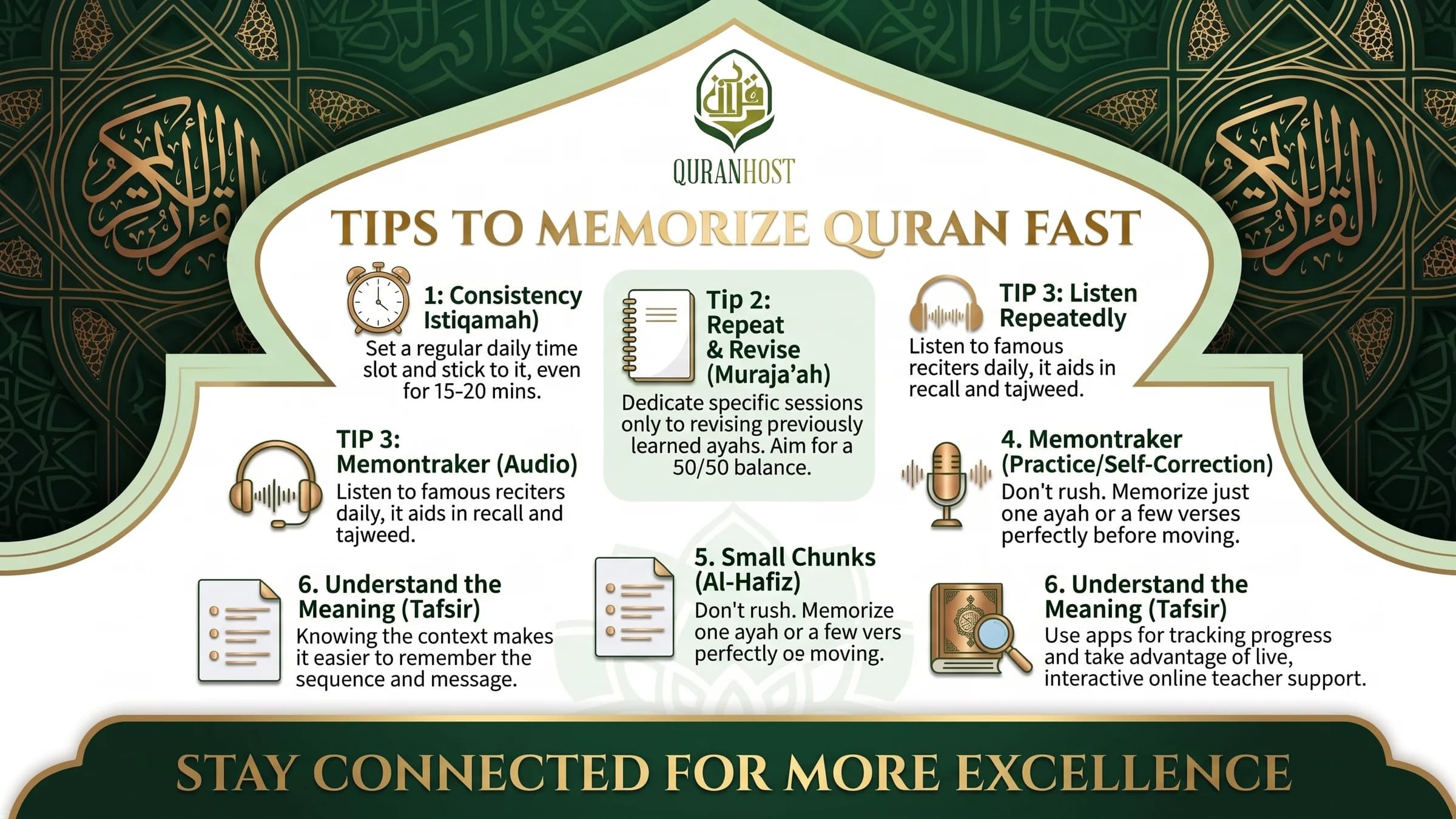
Memorizing the Quran online has become a practical option for people who cannot reach a mosque or madrassah for daily lessons. The method itself does not change: you still recite to a teacher who corrects you, and you still revise every day. What changes is that the lesson comes to you, at a time you choose. QuranHost runs a live one-to-one online Quran memorization course for exactly this, and the tips below are the habits that make the difference between memorizing a page and keeping it.
Tips to Memorize Quran Online

Quran memorization is a dream for every Muslim but it's a tough job. The techniques below are the ones Huffaz rely on, and they make it a manageable one. Here are some of the tricks;
The Sincerity of Intention
Islam lays great stress on purity of intention. Every act of a believer will be judged based on his intention on the day of judgment. So to memorize Quran online, it is significant to set a sincere intention. The intention should be to please Allah SWT, not to seek the attention of the folks. With purity of intention, Quran memorization will be a doable thing.
Seek the help of a Trained Teacher
Seeking the help of a trained Quran tutor can be helpful in Quran memorization online. In online Quran learning there is a chance of seeking help from trained teachers around the globe. If you join any online Quran institute like QuranHost, you can get an opportunity to acquire help from Egyptian Quran teachers. That can be helpful in an arduous journey of Quran memorization.
Seek Admission to Any Reputable Online Quran Academy
Every reliable Quran academy has a group of skilled teachers for online Quran learning. So seeking admission to a reputable online Quran academy is helpful in Quran memorization.
Repetition and Revision
Repetition and revision is the key to learning something. Similar is the case with Quran memorization. You should set a scheduled time for revising your lesson daily. In addition, lesson can be revised in prayers five times a day. This activity can enhance memory and make Quran memorization convenient.
Start With Shorter Surahs
One of the most practical tips is to begin with the shorter chapters of the Quran. The 30th Juz (Juz Amma) is an ideal starting point, because many of its surahs are brief and already familiar from your daily prayers. Memorizing these first builds your confidence and helps you settle into a steady rhythm before you move on to the longer surahs. Starting small keeps the journey encouraging rather than overwhelming, and every completed surah becomes a milestone that pushes you to continue.
Understand What You Memorize
Memorization becomes far easier when you understand the meaning of the verses you are learning. When the words carry meaning for you, your mind has something to hold on to and the verses connect naturally in sequence. Spend a few minutes reading a reliable translation of your daily portion, and where possible a short Tafseer. This habit not only strengthens your memory but also deepens your connection with the message of the Quran.
Listen to a Skilled Reciter
Listening repeatedly to one skilled Qari is a powerful aid for memorization. Hearing the same recitation again and again fixes the correct pronunciation, rhythm, and Tajweed in your mind, so you recall not just the words but the way they should sound. Choose a single reciter and stay with them throughout your Hifz, as switching too often can disturb the flow you have built. Listening during travel or daily chores quietly turns idle time into revision.
Listen, Then Recite Along
Listening on its own builds familiarity; listening and then reciting builds memory. Play your verse from one trusted reciter, listen closely to how the words join and where the stops fall, then recite it back without the audio until you can say it confidently on your own. Repeat that loop a few times before moving on. Working through your ears and your own voice together reinforces the verse from two directions at once and fixes accurate Tajweed as you go, which helps most with verses that are hard to pronounce or easy to confuse with similar ones.
Recite Your Portion in Daily Prayers
Your five daily prayers are a natural, built-in revision schedule. Reciting freshly memorized verses in Salah reinforces them through repetition while turning your practice into an act of worship. Across the day the same portion is revisited several times without any extra effort, which is one of the most effective and time-tested ways to protect what you have memorized from being forgotten.
Learn Alongside Others
Memorizing with company keeps you motivated and accountable. Studying alongside a family member, a friend, or a small group means you can test one another, share what works, and stay encouraged when progress feels slow. If you cannot find a group nearby, a regular class with a teacher gives you the same steady accountability.
Write Out the Verses You Struggle With
When a verse simply will not stick, try writing it out by hand a few times. Putting the words on paper makes you slow down and notice every letter and stopping point, which helps fix them in your memory. Many students keep a small notebook for the verses they find hardest and review it during revision.
Use a Single Mus’haf Throughout
Choose one copy of the Mushaf and stay with it for the whole of your Hifz. Your memory attaches itself to the layout of the page as much as to the words: where a verse begins, which line it sits on, what is at the top and bottom of the page. Change copies part way through and that visual anchor is gone, which is why many students suddenly stumble on passages they knew well. Huffaz commonly use either the 15-line Madani Mushaf or the 16-line Indo-Pak Mushaf. Neither is required. What matters is that you pick one and do not switch.
Break the Page Into Small Portions
Rather than reading a whole page over and over, divide it into small portions of two or three lines. Repeat the first portion aloud until it is firm, then the second, then join the two together before you go on. Build the page piece by piece and join each new portion to what came before. This gives your mind clear, connected units to store instead of one long blurred stretch of text, and it means you notice straight away which lines are not holding.
Follow the Sabaq, Sabqi and Manzil Cycle
Every session should contain three things, and this cycle is the backbone of a Hifz that lasts. Sabaq is today’s new lesson. Sabqi is the recent material you memorized over the past days and weeks, revised while it is still fragile. Manzil is the older, settled portion you rotate through on a regular cycle. Skip the second and third and your new pages will keep displacing the old ones. For the full method, daily schedules and how the three are balanced as your memorized total grows, see our complete guide to memorizing the Quran online.
Recite Aloud Rather Than Silently
Reciting under your breath feels quicker, but saying the words out loud retains better. Hearing your own voice lets you catch a mispronunciation on the spot rather than repeating it a hundred times, and it gives your teacher something to correct in the lesson. It also slows you down just enough to notice the letters you are rushing. Keep the volume low if you need to, but keep it audible.
How Fast Can You Really Memorize the Quran?
There is no genuine shortcut, and it is worth being clear about that before you set a date. Completing Hifz often takes several years, and the time varies considerably with age, reading fluency, how much you can study each day, and above all how consistent your revision is. Some intensive full-time students finish sooner.
What the habits on this page actually do is make each day more productive. Memorizing faster means wasting less effort, not compressing the Quran into a few weeks. The real limit is not how much you can take in during one sitting but how much you can still recite accurately the next morning, so if a target would mean cutting revision to fit new material in, the target is wrong rather than the pace. For what different timelines demand of you day to day, see our guide on memorizing the Quran in one year.
Conclusion
None of these habits is complicated. What makes them work is doing them on the days you do not feel like it, and having someone who will hear your mistakes. QuranHost has designed an online Quran memorization course. This course aims at minimizing hurdles in the Quran memorization journey. Come and get yourself registered for the Quran memorization journey.