


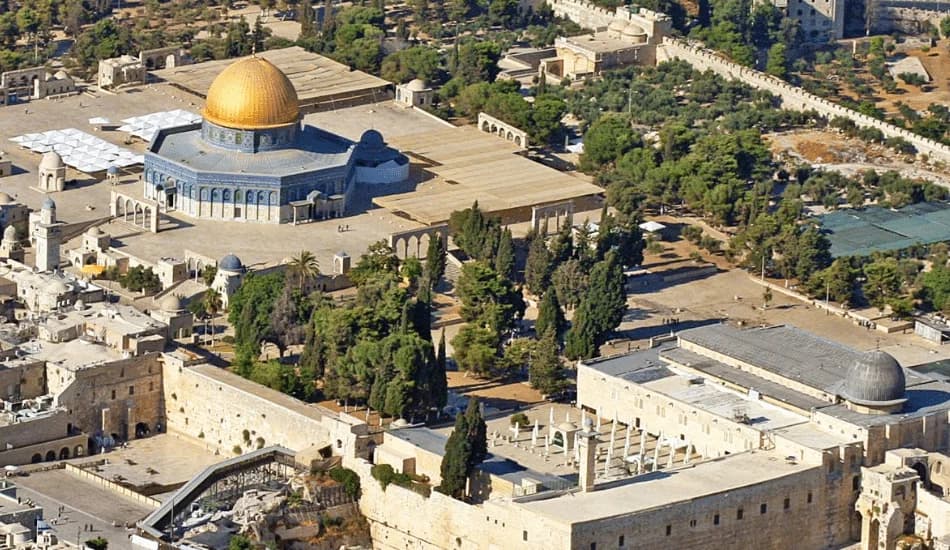
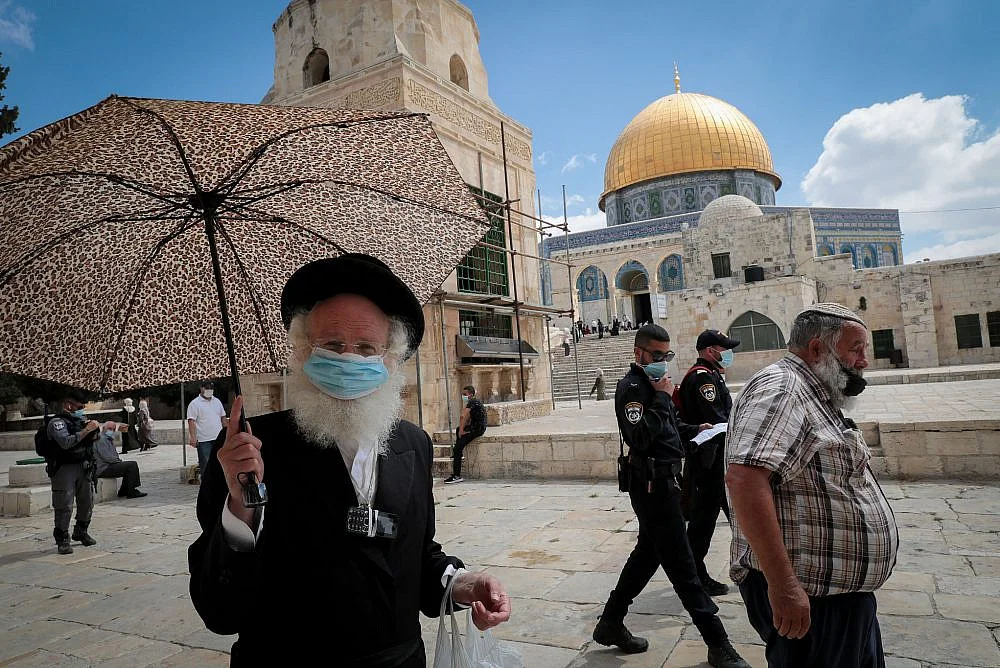
Masjid al-Aqsa, “the Farthest Mosque,” stands on a hilltop in the Old City of Jerusalem. In Islamic usage the name covers the whole walled compound, including the silver-domed Qibli Mosque and the golden Dome of the Rock. It is the third holiest site in Islam, the first direction of prayer (qiblah) for Muslims, and the place to which the Prophet ﷺ was taken on the Night Journey.
The same hilltop is the Temple Mount in Judaism, the site of the ancient First and Second Temples and the holiest place in the Jewish faith. This article explains what the site means to each, and how its buildings came to be.
What “Masjid al-Aqsa” Refers To
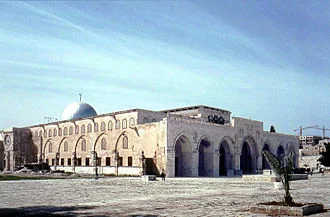
Two names are easily confused. Al-Masjid al-Aqsa refers to the entire compound, which Muslims also call al-Haram al-Sharif, the Noble Sanctuary. Al-Jami‘ al-Aqsa, often called the Qibli Mosque, is the main congregational prayer hall on its southern side (Wikipedia, “Al-Aqsa”).
The compound is administered by the Jerusalem Islamic Waqf, a religious trust (Wikipedia, “Al-Aqsa”).
Why Al-Aqsa Is Sacred to Muslims
The Night Journey
The Quran begins Surah al-Isra with the Prophet’s ﷺ journey by night to al-Aqsa:
سُبْحَـٰنَ ٱلَّذِىٓ أَسْرَىٰ بِعَبْدِهِۦ لَيْلًا مِّنَ ٱلْمَسْجِدِ ٱلْحَرَامِ إِلَى ٱلْمَسْجِدِ ٱلْأَقْصَا ٱلَّذِى بَـٰرَكْنَا حَوْلَهُۥ لِنُرِيَهُۥ مِنْ ءَايَـٰتِنَآ ۚ إِنَّهُۥ هُوَ ٱلسَّمِيعُ ٱلْبَصِيرُ“Exalted is He who took His Servant [i.e., Prophet Muḥammad (ﷺ)] by night from al-Masjid al-Ḥarām to al-Masjid al-Aqṣā, whose surroundings We have blessed, to show him of Our signs. Indeed, He is the Hearing, the Seeing.”
Quran 17:1, translation: Sahih International.
In Sahih Muslim, the Prophet ﷺ describes seeing the earlier prophets on that journey and says, “When the time of prayer came, I led them” (Sahih Muslim 172), which is why Muslims link al-Aqsa with all the prophets.
The first qiblah
After the Hijrah, the Prophet ﷺ and the Muslims prayed facing Jerusalem for sixteen or seventeen months, until the direction of prayer was changed to the Kaaba in Makkah (Sahih al-Bukhari 40; Quran 2:144).
One of the three mosques
The Prophet ﷺ singled out al-Aqsa as one of three mosques worth a special journey:
لاَ تُشَدُّ الرِّحَالُ إِلاَّ إِلَى ثَلاَثَةِ مَسَاجِدَ الْمَسْجِدِ الْحَرَامِ وَمَسْجِدِ الرَّسُولِ ﷺ وَمَسْجِدِ الأَقْصَى“Do not set out on a journey except to three mosques: al-Masjid al-Haram, the Mosque of the Messenger ﷺ, and al-Masjid al-Aqsa.”
Sahih al-Bukhari 1189, narrated by Abu Hurayrah; also in Sahih Muslim.
The second mosque on earth
Abu Dharr asked the Prophet ﷺ which mosque was built first:
قُلْتُ يَا رَسُولَ اللَّهِ أَىُّ مَسْجِدٍ وُضِعَ فِي الأَرْضِ أَوَّلُ قَالَ الْمَسْجِدُ الْحَرَامُ قَالَ قُلْتُ ثُمَّ أَىٌّ قَالَ الْمَسْجِدُ الأَقْصَى قُلْتُ كَمْ كَانَ بَيْنَهُمَا قَالَ أَرْبَعُونَ سَنَةً“I said, ‘O Messenger of Allah, which mosque was set up on earth first?’ He said, ‘Al-Masjid al-Haram.’ I said, ‘Then which?’ He said, ‘Al-Masjid al-Aqsa.’ I said, ‘How long was there between them?’ He said, ‘Forty years.’”
Sahih al-Bukhari 3366, narrated by Abu Dharr. The English is QuranHost’s rendering.
A land of the prophets
The Quran describes the surroundings of al-Aqsa as blessed (17:1). The region is associated with many prophets mentioned in the Quran, including Ibrahim, Dawud, Sulayman, Zakariyya, Yahya and Isa, and the Prophet ﷺ related that Musa asked Allah to bring him near the Holy Land at his death (Sahih al-Bukhari 1339). Read more about them in our guide to the 25 prophets named in the Quran.
The Dome of the Rock
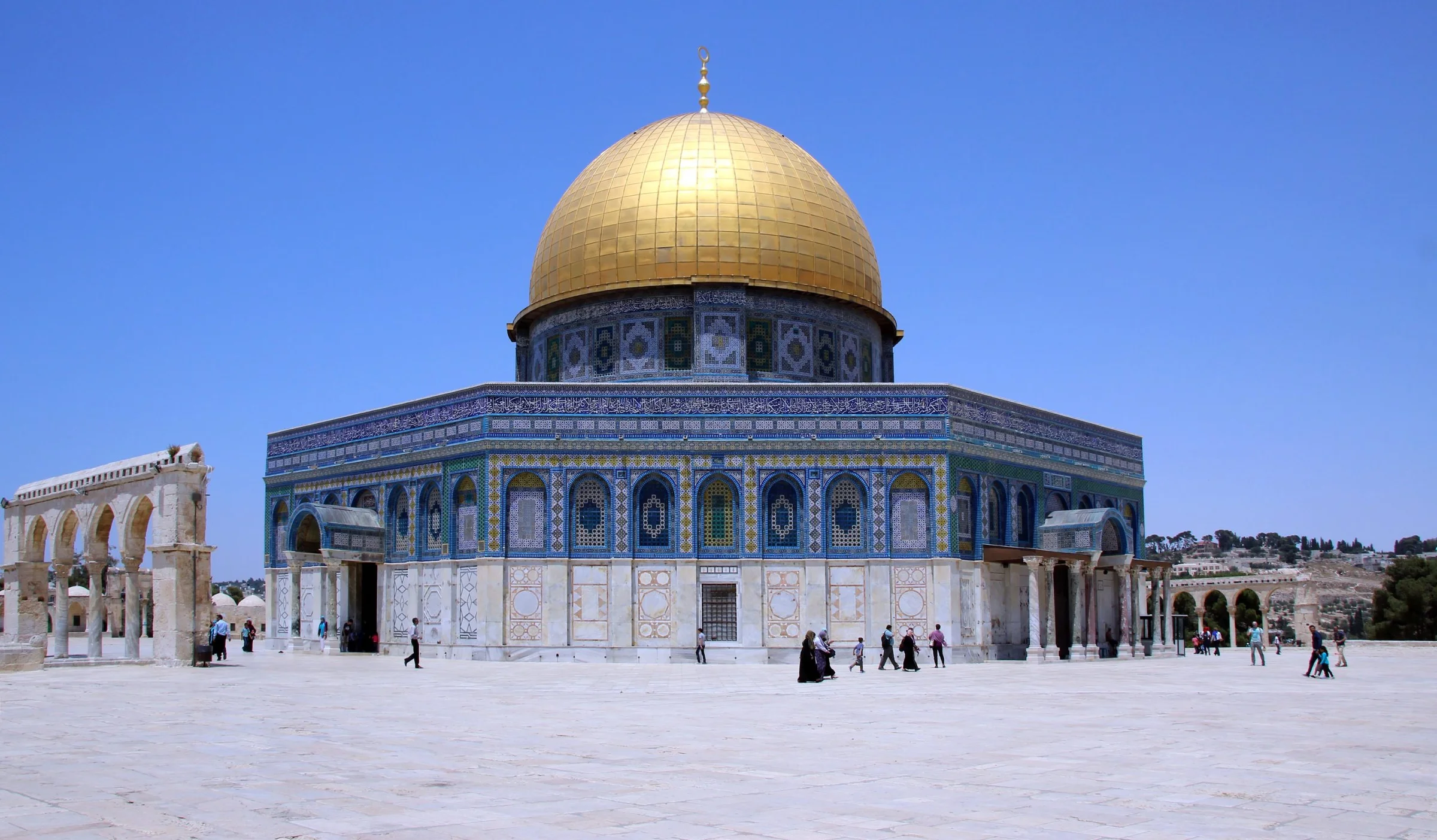
The Dome of the Rock is an octagonal shrine at the center of the compound, built over a rock outcrop. It was built on the orders of the Umayyad caliph Abd al-Malik ibn Marwan and completed in 72 AH (691–692 CE), the date recorded in its dedicatory inscription, making it the oldest surviving major work of Islamic architecture (Wikipedia, “Dome of the Rock”).
In Muslim belief, the Prophet’s ﷺ ascension (Mi‘raj) began from this rock, and today many Muslims see the building as commemorating that event. Its original inscriptions do not mention the Night Journey; they quote Quranic verses about Isa (Jesus) instead (Wikipedia, “Dome of the Rock”; full transcription: Islamic Awareness, “The Arabic Islamic Inscriptions on the Dome of the Rock”). The Dome is a shrine; the main congregational prayers are held in the Qibli Mosque.
A Short History of the Mosque
| When | What happened |
|---|---|
| 637–638 CE | Jerusalem comes under Muslim rule during the caliphate of Umar. Islamic tradition credits Umar with a simple prayer hall on the site. |
| Later 7th century CE | The pilgrim Arculf describes a simple wooden house of prayer holding about 3,000 worshipers. Sources date his visit between about 670 and 682. |
| c. 685–715 CE | The Umayyad caliphs Abd al-Malik (r. 685–705) and his son al-Walid I (r. 705–715) build the congregational mosque. Historians differ over how much of it each built. |
| 8th and 11th centuries CE | Earthquakes badly damage the mosque. The Abbasid caliphs al-Mansur (758) and al-Mahdi (780) rebuild it, and after the earthquake of 1033 the Fatimid caliph al-Zahir rebuilds it on the plan the present mosque still largely follows. |
| 1099 CE | The Crusaders take Jerusalem and use the building as a palace and as a headquarters of the Knights Templar. |
| 1187 CE | Saladin (Salah al-Din) retakes Jerusalem and restores the building as a mosque. |
Sources: Wikipedia, “Al-Aqsa Mosque”; Madain Project, “History of Masjid Aqsa”.
Why the Site Matters to Jews
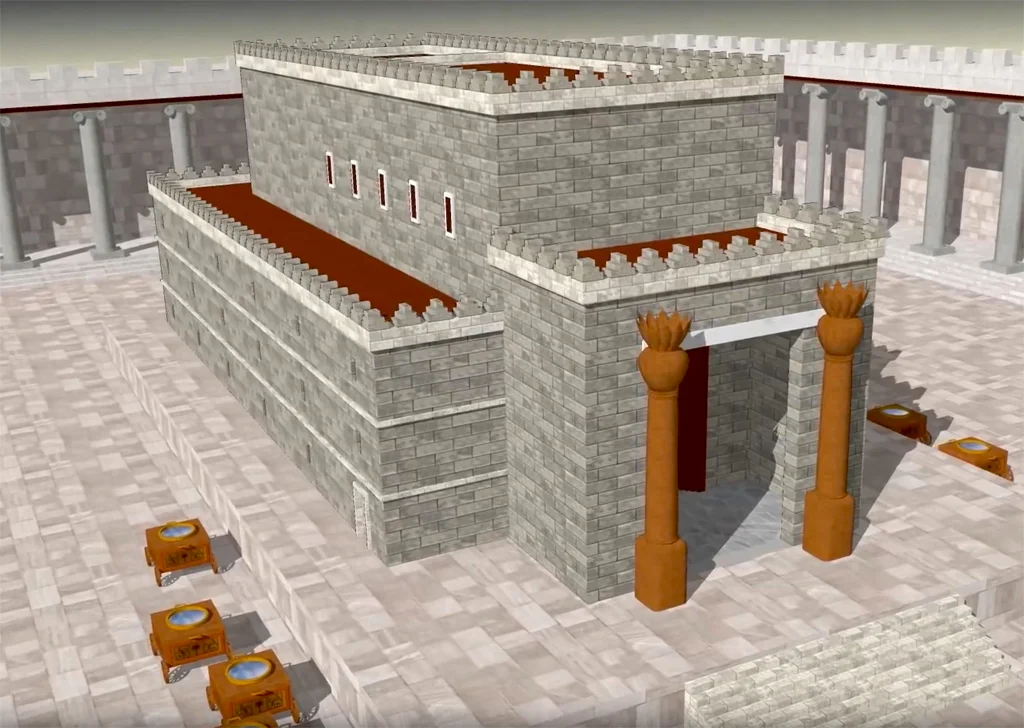
In Judaism the hilltop is the Temple Mount, the holiest site in the Jewish faith:
- The First Temple, which the Hebrew Bible attributes to King Solomon (the Prophet Sulayman in Islam), stood here until the Babylonians destroyed it in 587 BCE.
- The Second Temple was built in about 516 BCE, later expanded by Herod, and destroyed by the Romans in 70 CE.
- Mount Moriah: Jewish tradition identifies the hill with the place where Abraham bound his son Isaac.
- A future Temple: Jewish texts speak of a Third Temple to be built in the messianic age.
Jews traditionally pray facing Jerusalem and the Temple Mount.
The Western Wall
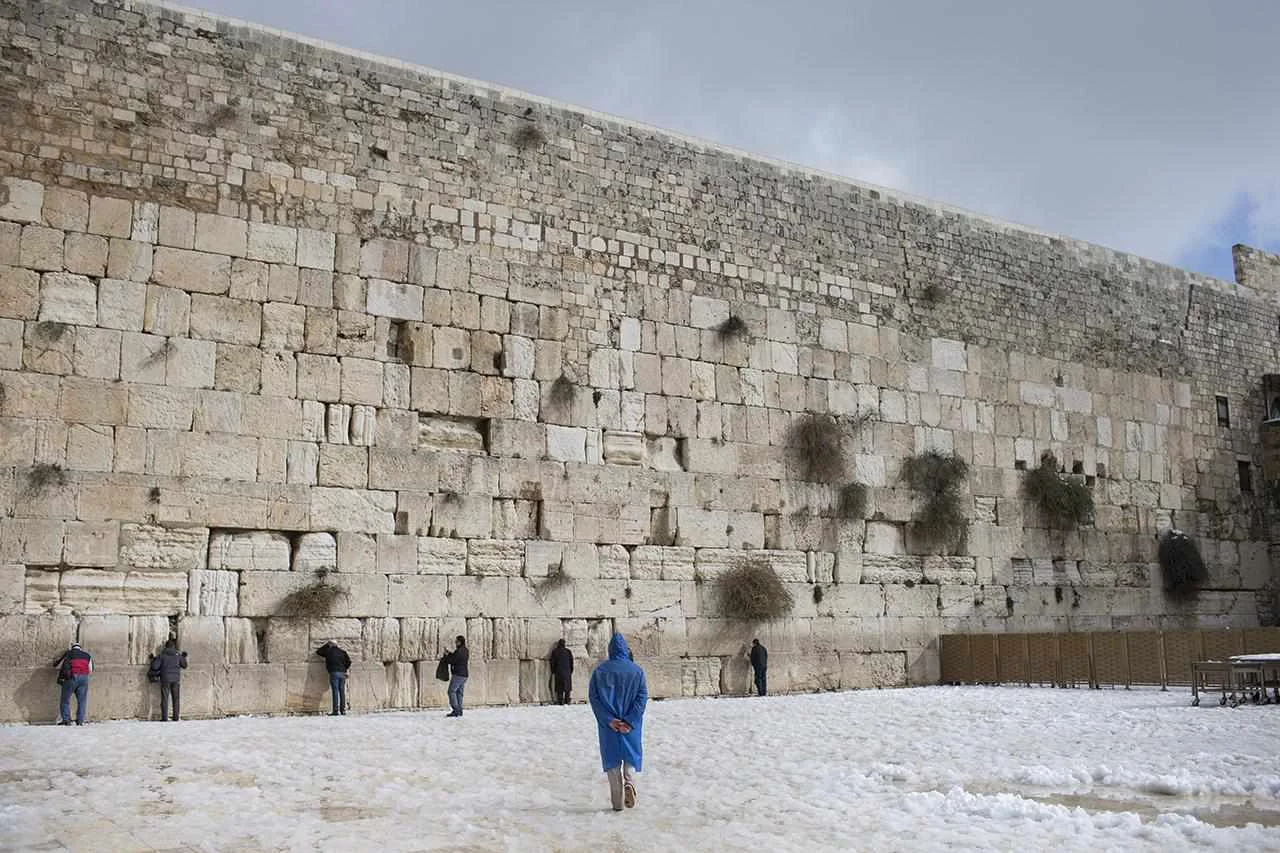
The Western Wall is not part of the Temple building itself. It is a section of the ancient retaining wall that Herod built around 19 BCE to support the platform of the Second Temple compound. Today it is a central place of Jewish prayer. In English it is also called the Wailing Wall. Muslims know it as the Buraq Wall, from the belief that the Prophet ﷺ tethered his mount, al-Buraq, nearby during the Night Journey (Wikipedia, “Western Wall”).
Gaza in November 2023
This section describes the situation in early November 2023, when this article was first published. It is kept as a record of that time and does not describe events since then.
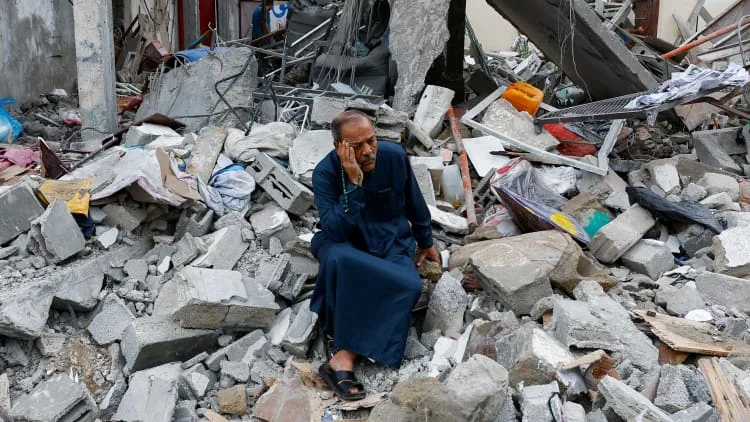
On October 7, 2023, Hamas and other Palestinian armed groups attacked southern Israel. Hundreds of people were killed in Israel, most of them civilians, and more than two hundred were taken captive into Gaza. Israel responded with heavy airstrikes on the Gaza Strip and then a ground offensive.
By early November, according to figures from the Ministry of Health in Gaza reported by the United Nations, thousands of Palestinians had been killed, many of them children and women, and many more were reported missing under the rubble. Hundreds of thousands of people had been displaced, and hospitals in northern Gaza were struggling to keep running for lack of fuel.
Source: UN OCHA, “Hostilities in the Gaza Strip and Israel, Flash Update #33” (November 8, 2023).
Al-Aqsa Today
Because the compound is holy to Muslims and the hilltop is holy to Jews, al-Aqsa is often at the center of political tension and appears frequently in the news. For current events, rely on reputable news sources. For its religious meaning, the Quran and the Prophet’s ﷺ words above remain the starting point for Muslims.
Related reading: the 25 prophets named in the Quran. To study Islamic history with a teacher, see our Islamic teachings course.