


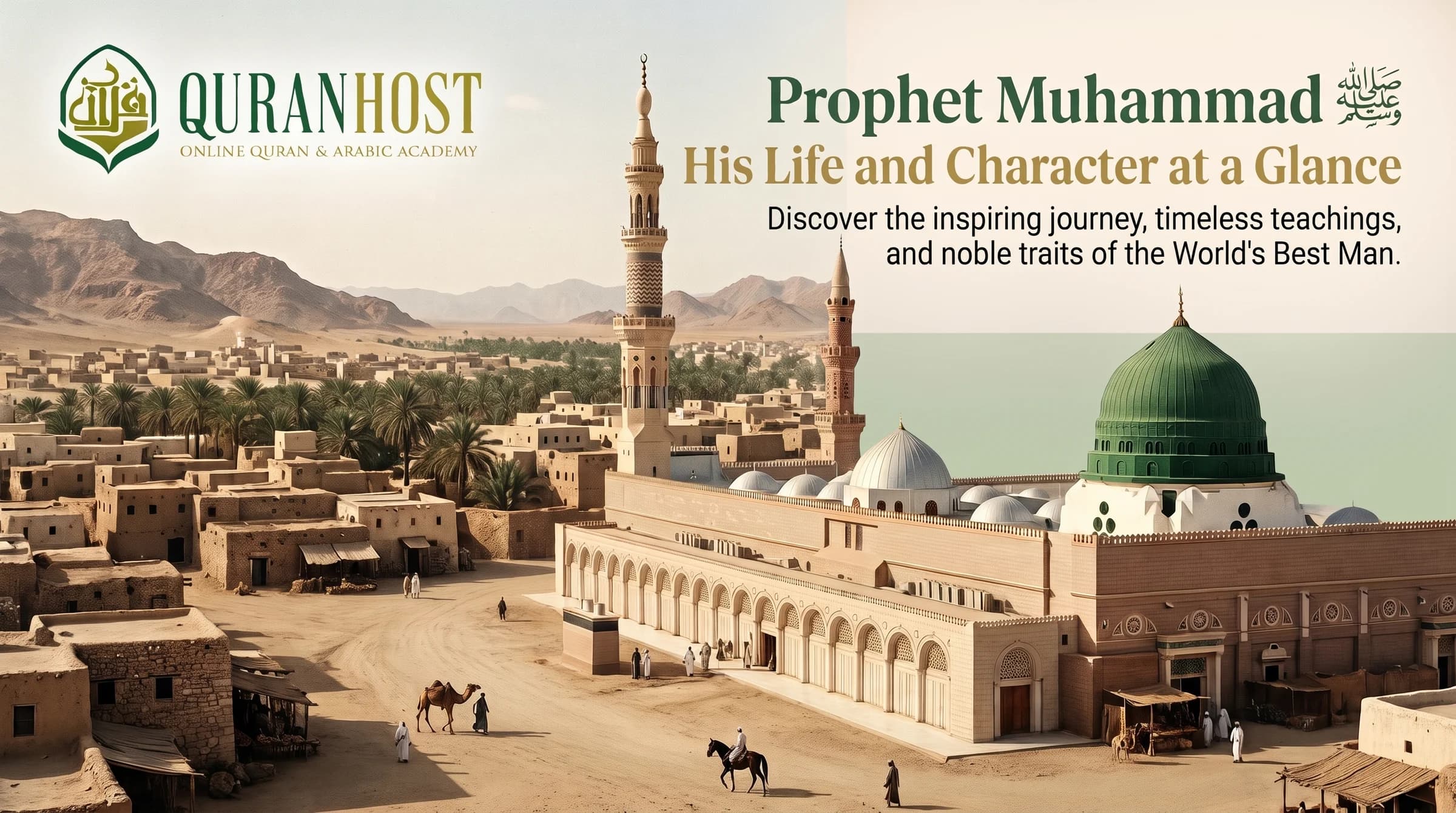
Muslims regard Prophet Muhammad ﷺ as the best of all people and the final messenger of Allah, sent to all of humanity. He was born in Makkah around 570 CE, received the first revelation of the Quran at the age of forty, migrated to Madinah in 622 CE, and died there in 632 CE at the age of sixty-three. Muslims look to his life, called the seerah, and to his teaching and example, the Sunnah, as the model for their own.
His influence reaches far beyond the Muslim world. In his 1978 book The 100: A Ranking of the Most Influential Persons in History, the American writer Michael H. Hart placed him first. This article gives a short overview of his life and character, and explains why Muslims call him the best of mankind.
Prophet Muhammad ﷺ: A Short Timeline
| Year (CE) | Event |
|---|---|
| c. 570 | Born in Makkah, in the Year of the Elephant |
| 578 | His grandfather Abd al-Muttalib dies; his uncle Abu Talib takes him in (his mother had died earlier) |
| c. 595 | Marries Khadijah bint Khuwaylid |
| 610 | First revelation in the cave of Hira |
| c. 613 | Begins calling people to Islam publicly |
| 615 | A group of Muslims emigrates to Abyssinia |
| c. 619 | Khadijah and Abu Talib die |
| 622 | The Hijrah to Madinah |
| 624, 625, 627 | The battles of Badr, Uhud and the Trench |
| 628 | The Treaty of Hudaybiyyah |
| 630 | Makkah comes under Muslim rule, with little fighting |
| 632 | The Farewell Hajj; he dies in Madinah |
Years follow the PBS, “Muhammad: Legacy of a Prophet” timeline; the dates for Abyssinia and the deaths of Khadijah and Abu Talib are approximate.
Early Life
He was born on a Monday (Sahih Muslim 1162) in the Year of the Elephant, into the Hashim clan of the Quraysh tribe, descendants of the Prophet Ismail, son of Ibrahim. His father Abdullah died before he was born, and the biographies record that he lost his mother Aminah when he was about six. He was then cared for by his grandfather Abd al-Muttalib and, after his grandfather’s death, by his uncle Abu Talib.
Following the custom of the Quraysh, he spent his early childhood with a foster family of the Banu Sa‘d in the desert, nursed by Halimah al-Sa‘diyyah. As a young man he worked as a trader, and the people of Makkah knew him as al-Amin, the trustworthy. At twenty-five he married Khadijah bint Khuwaylid (IslamQA 110501).
The First Revelation
Before his prophethood he would spend periods alone in worship in the cave of Hira, near Makkah. There, at the age of forty, the angel Jibril came to him and commanded him to read. He replied that he was not a reader, and the first verses of the Quran were revealed (Sahih al-Bukhari 3):
ٱقْرَأْ بِٱسْمِ رَبِّكَ ٱلَّذِى خَلَقَ (١) خَلَقَ ٱلْإِنسَـٰنَ مِنْ عَلَقٍ (٢) ٱقْرَأْ وَرَبُّكَ ٱلْأَكْرَمُ (٣) ٱلَّذِى عَلَّمَ بِٱلْقَلَمِ (٤) عَلَّمَ ٱلْإِنسَـٰنَ مَا لَمْ يَعْلَمْ (٥)(1) Recite in the name of your Lord who created (2) Created man from a clinging substance. (3) Recite, and your Lord is the most Generous - (4) Who taught by the pen (5) Taught man that which he knew not.
Quran 96:1-5, translation: Sahih International.
He returned home shaken, and Khadijah comforted him, saying that Allah would never disgrace him, because he kept ties of kinship, helped the weak and the poor, honored guests and supported people in hardship (Sahih al-Bukhari 3).
From Makkah to Madinah
For about thirteen years he called the people of Makkah to worship Allah alone. He and his followers faced boycott and persecution, and some Muslims sought refuge in Abyssinia. In 622 CE he migrated to Madinah, an event known as the Hijrah, from which the Islamic calendar is counted.
In Madinah he led a new community. An early document known as the Constitution of Medina set out the rights and duties of the Muslims, the Jewish tribes and the other groups of the city (Wikipedia, “Constitution of Medina”). In 6 AH (628 CE) he agreed the Treaty of Hudaybiyyah with the Quraysh, and in 8 AH (630 CE) he entered Makkah with the Muslims and the city came under their rule.
His Character
The Quran addresses him directly:
وَإِنَّكَ لَعَلَىٰ خُلُقٍ عَظِيمٍ“And indeed, you are of a great moral character.”
Quran 68:4, translation: Sahih International.
When Sa‘d ibn Hisham asked Aishah about the Prophet’s ﷺ character, she asked whether he read the Quran, and when he said yes, she said:
فَإِنَّ خُلُقَ نَبِيِّ اللَّهِ ﷺ كَانَ الْقُرْآنَ“The character of the Prophet of Allah ﷺ was the Quran.”
Sahih Muslim 746, narrated by Aishah.
What the Quran commands, he practiced; what it forbids, he avoided. At home he helped his family: asked what he did in his house, Aishah said he would keep busy serving his family until it was time for prayer (Sahih al-Bukhari 676).
Why Muslims Call Him the Best of Mankind
When Muslims call him the best man in the world, they mean that they regard him as the best of all people. He said of himself:
أَنَا سَيِّدُ وَلَدِ آدَمَ يَوْمَ الْقِيَامَةِ وَأَوَّلُ مَنْ يَنْشَقُّ عَنْهُ الْقَبْرُ وَأَوَّلُ شَافِعٍ وَأَوَّلُ مُشَفَّعٍ“I will be the leader of the children of Adam on the Day of Resurrection, the first whose grave will open, the first to intercede and the first whose intercession is accepted.”
Sahih Muslim 2278, narrated by Abu Hurayrah. The English is QuranHost’s rendering.
Yet when a man once addressed him as “best of creation,” he replied, “That is Ibrahim” (Sahih Muslim 2369). Hadith scholars, citing al-Nawawi’s commentary on Sahih Muslim, explain that he said this out of humility and respect for the Prophet Ibrahim (HadithAnswers).
Mercy, Equality and Justice
The Quran describes his mission as a mercy:
وَمَآ أَرْسَلْنَـٰكَ إِلَّا رَحْمَةً لِّلْعَـٰلَمِينَ“And We have not sent you, [O Muḥammad], except as a mercy to the worlds.”
Quran 21:107, translation: Sahih International.
He taught that worth before Allah is measured by righteousness, not by tribe or race, as the Quran states:
إِنَّ أَكْرَمَكُمْ عِندَ ٱللَّهِ أَتْقَىٰكُمْ“Indeed, the most noble of you in the sight of Allāh is the most righteous of you.”
Quran 49:13, translation: Sahih International.
In his sermon at Arafat during the Farewell Hajj, he declared that people’s lives and property were sacred, abolished the blood feuds and usury of the pre-Islamic era, and told the men to fear Allah in their treatment of women, reminding them that women have rights over them (Sahih Muslim 1218). He also said, “The best of you is the best to his wives, and I am the best of you to my wives” (Jami‘ at-Tirmidhi 3895; graded sahih by Zubair Ali Za’i).
People of Other Faiths
Two Companions, Sahl ibn Hunayf and Qays ibn Sa‘d, reported:
إِنَّ النَّبِيَّ ﷺ مَرَّتْ بِهِ جَنَازَةٌ فَقَامَ فَقِيلَ لَهُ إِنَّهَا جَنَازَةُ يَهُودِيٍّ فَقَالَ أَلَيْسَتْ نَفْسًا“A funeral passed by the Prophet ﷺ and he stood up. He was told, ‘It is the funeral of a Jew.’ He said, ‘Is it not a soul?’”
Sahih al-Bukhari 1312, narrated by Sahl ibn Hunayf and Qays ibn Sa‘d.
Conduct in War
He led the Muslims in a number of battles against the Quraysh and their allies, and he set limits on warfare. When a woman was found killed after one battle, he forbade the killing of women and children (Sahih al-Bukhari 3015). He also made and kept treaties, such as the Treaty of Hudaybiyyah.
Husband, Father and Grandfather
He was married to Khadijah alone for about twenty-five years, until her death. After that he married several other women, among them Aishah bint Abi Bakr, who became one of the most important narrators of hadith. According to the majority of scholars, he was married to eleven wives in all, and nine were living at the time of his death (IslamQA 47072). The Quran calls his wives the mothers of the believers (33:6).
He had seven children: three sons, all of whom died in childhood, and four daughters. Our article on the children of the Prophet ﷺ lists them. He was openly affectionate with his grandchildren, and he even carried his granddaughter Umamah while leading the prayer (Sahih al-Bukhari 516).
The Question of Aishah’s Age
In a report recorded in Sahih al-Bukhari and Sahih Muslim, Aishah says that the Prophet ﷺ married her when she was six and that the marriage was consummated when she was nine (Sahih al-Bukhari 5134; Sahih Muslim 1422).
Aishah became one of the most knowledgeable women in the Muslim community, and senior Companions consulted her on religious questions (IslamQA 44990).
The Final Years
In 10 AH (632 CE) he performed his only Hajj after the Hijrah, known as the Farewell Hajj, and delivered the sermon at Arafat. A few months later he fell ill, and he died in Madinah on a Monday in Rabi‘ al-Awwal 11 AH (Sahih al-Bukhari 1387), at the age of sixty-three (Sahih al-Bukhari 3536). Read more in our guide to the month of Rabi‘ al-Awwal.
The Quran calls him the seal of the prophets:
وَلَـٰكِن رَّسُولَ ٱللَّهِ وَخَاتَمَ ٱلنَّبِيِّـۧنَ“[He is] the Messenger of Allāh and seal [i.e., last] of the prophets.”
Quran 33:40, translation: Sahih International.
His Legacy
His companions preserved the Quran and his Sunnah and carried them far beyond Arabia. For Muslims today, his life remains a practical guide to worship, family life, honesty in trade, justice and mercy. Learning his seerah is one of the best ways to understand both the Quran and the faith he taught.
Related reading: the ten companions promised Paradise, and the 25 prophets named in the Quran, of whom he is the seal. To study the seerah with a teacher, see our Islamic teachings course.