


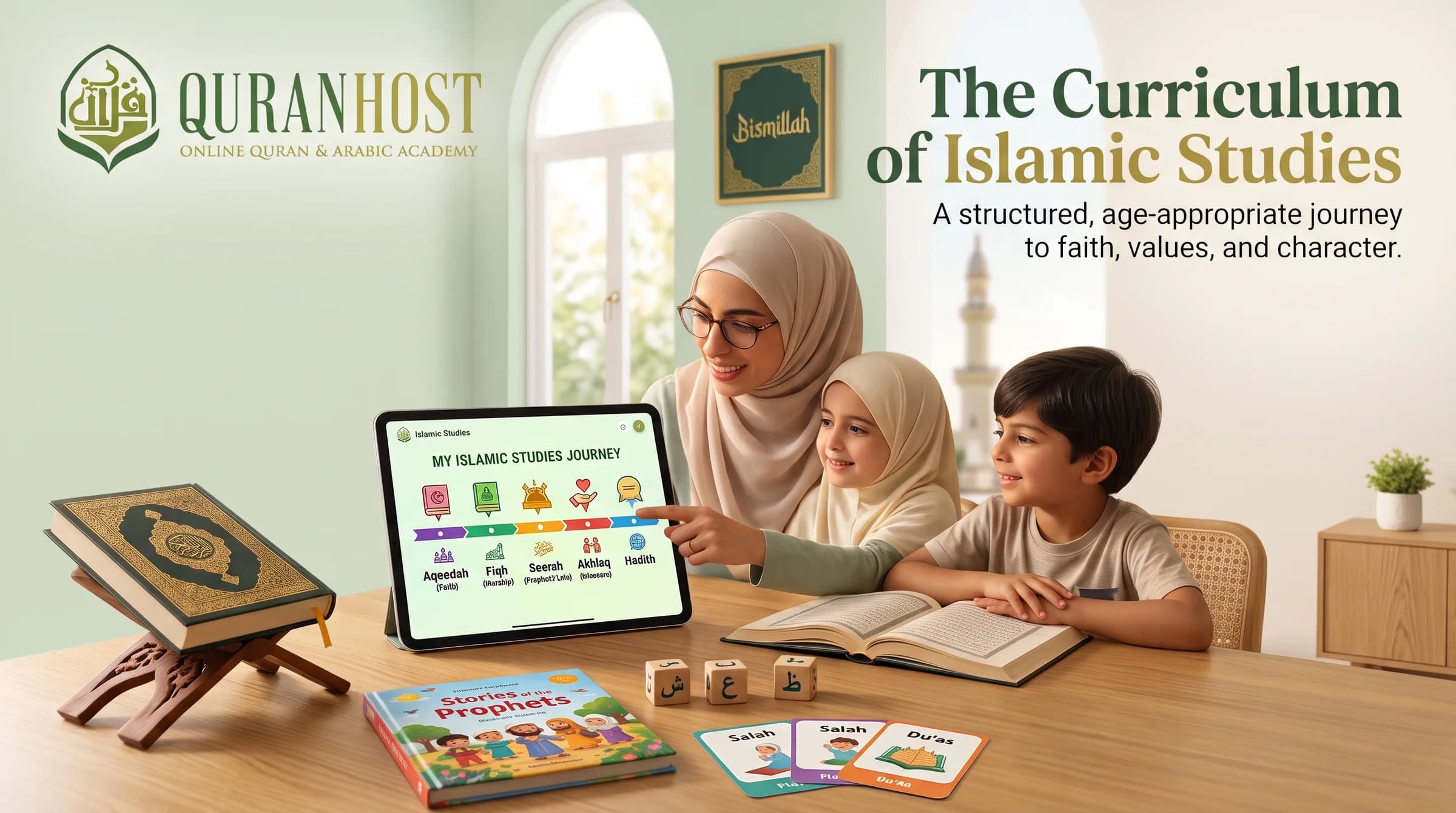
An Islamic studies curriculum for children covers what Muslims believe, how they worship, what the Quran teaches, the life of the Prophet Muhammad (peace be upon him), and the manners and duas of daily life. A good one teaches these a little at a time, at a level the child can understand, and connects every lesson to something the child can do.
Use this guide by starting from what your child already understands and can practice, not from their age alone. A ten-year-old who is new to Islam may need to begin with the youngest stage below, and a confident seven-year-old may be ready for parts of the next one. The age bands are a starting point for planning, not a test your child has to pass.
An Islamic Studies Syllabus for Children, by Age
The three stages below are an illustrative learning pathway, not a universal standard or QuranHost’s official term plan. Each gives a learning goal, an activity you can try, and a sign that shows your child has understood. One topic, preparing for prayer with wudu (the washing before prayer), runs through all three so you can see how the same lesson grows with the child.
Ages 5–7: Learning by Doing and Naming
- Learning goal: know that Allah is One and made everything, recognize the five pillars by name, learn a few daily duas, and know a short surah by heart with its simple meaning.
- Activity: put picture cards of the wudu steps in the right order, then do wudu together while saying each step out loud.
- Sign of understanding: your child can order the cards on their own and reminds you of a step you skipped.
Ages 8–11: Explaining the Why
- Learning goal: perform wudu and the daily prayers correctly, know the main events of the Prophet’s life in order, understand the meaning of the surahs they recite, and begin to explain why Muslims do what they do.
- Activity: your child demonstrates wudu and explains each step to a younger sibling or to you, including what to do if they are unsure whether a step was done.
- Sign of understanding: they can teach the sequence without prompting and answer a simple “what if” question in their own words.
Ages 12–15: Applying It to Real Life
- Learning goal: connect belief to choices, understand the purpose behind acts of worship, study selected hadith on character, and discuss how faith fits school, friendships and screens.
- Activity: talk through a realistic school day: where and when they could make wudu, how to plan a prayer around classes or sports practice, and what to say if a friend asks about it.
- Sign of understanding: your teen plans the day themselves and can explain their reasons calmly to someone who does not share their faith.
What Each Subject Contributes
Most Islamic studies syllabuses for children share the same six areas. Here is what each one adds to a child’s understanding.
- Aqidah (core beliefs). Belief in Allah, His angels, His books, His messengers, the Last Day, and His decree. Young children learn that Allah is One and cares for them. Older children learn to explain these beliefs and to ask questions about them.
- Quran: selected short surahs with meaning. Children learn short surahs they use in prayer, and what those surahs mean. This is different from a dedicated Quran reading, Tajweed (correct recitation) or Hifz (memorization) program, which teaches a child to read and recite the whole Quran. If that is what you need, see our guide to choosing the right Quran course for your child.
- Worship and everyday fiqh. Fiqh means the practical rulings of Islam. For children, that means how to make wudu, pray, fast and give, at the level they need now, not advanced legal debates.
- Seerah and age-appropriate Islamic history. Seerah is the life of the Prophet (peace be upon him). Younger children hear stories; older children learn the order of events and what the early Muslims faced.
- Selected hadith. A hadith is a reported saying or action of the Prophet (peace be upon him). Children learn a few short, well-established sayings about kindness, honesty and good manners. Collections such as Riyad as-Salihin, compiled by Imam al-Nawawi, are arranged by topics of character and conduct, which makes it easy to choose one selected narration that fits the week’s theme. A teacher can confirm the authenticity of any narration you choose, because not every report carries the same grading.
- Adab, duas and daily practice. Adab means good manners: respect for parents and teachers, kindness, keeping promises. Duas are short supplications for everyday moments, such as before eating or sleeping.
Why Character Matters More Than Memorized Facts
The aim of Islamic studies is not that a child can recite definitions or list events in order. It is that what they learn shapes how they behave. Learning about honesty matters most when telling the truth is difficult: when owning up to a broken cup means getting into trouble, or when a friend wants help copying homework.
You can talk about this without turning it into a test. Share a time you found it hard to be honest yourself, ask “What made it hard?” rather than “What is the right answer?”, and thank your child when they own up to something, even while you deal with the mistake itself.
A Sample Week on Honesty
This is a sample to show how one theme can become a family week. It is not a QuranHost lesson plan.
- What your child hears or reads: the story of how, before he became a prophet, the people of Makkah called Muhammad (peace be upon him) al-Amin, the trustworthy one, and left their valuables with him.
- What the family discusses: why would people trust someone with their belongings? What does it take to earn that kind of trust, and how quickly can it be lost?
- One thing to practice: for one week, everyone in the family owns up to one small mistake out loud, and the rest of the family says “thank you for telling us” before anything else.
- End-of-week reflection: “When was it hardest to be honest this week, and what helped you do it?”
For a younger child: act out the story with toys, then play a short game where they “hand over” a toy to keep safe and return it later. For a teen: discuss a realistic case, such as a group chat sharing test answers, and talk through what honesty looks like when it could cost them friends.
Getting Guided Lessons
Some families plan this at home; others want a teacher to guide it. If you would like one-to-one lessons that follow these subjects at your child’s pace, see our Islamic studies course for kids.
Frequently Asked Questions
Practical questions about planning or checking your child’s Islamic studies syllabus.