


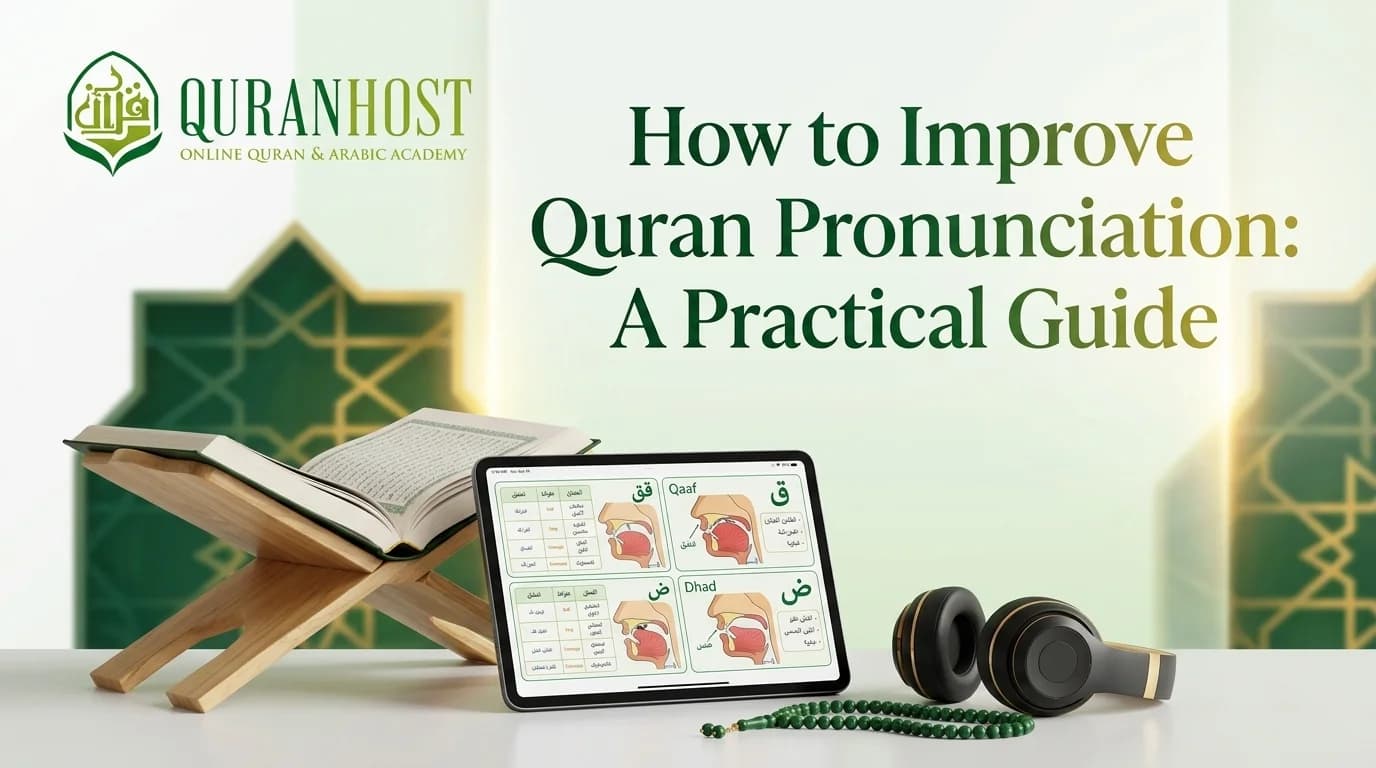
If you want to know how to improve Quran pronunciation, the short answer is that it takes three things together: understanding where each Arabic sound is produced, practising those sounds slowly and deliberately, and having your recitation checked by someone who can hear what you cannot. Reading about pronunciation will not change how you sound. Structured listening and repetition will.
This guide explains what accurate Quran pronunciation involves, which sounds learners most often confuse, and how to build a practice routine you can keep up. It is written for readers who already recognise the Arabic letters, or are close to that point.
What correct Quran pronunciation involves
Accurate pronunciation of Quran text means giving every letter its proper sound, in its proper place, with its proper qualities. Arabic has sounds absent from English, and pairs that seem identical to an untrained ear. Producing them is a physical skill, which is why it responds to practice rather than theory.
Three elements matter most:
- Articulation point (the makhraj): the place in the mouth or throat where the sound is formed.
- Letter characteristics (the sifaat): qualities such as whether a sound is voiced or whispered, heavy or light.
- Consistency: producing the same letter the same way each time, regardless of the surrounding word.
English letters shift their sound depending on the word. Arabic letters keep their identity, so once learned properly a sound stays stable. That is what makes deliberate practice effective.
Pronunciation and the wider rules of Tajweed
Tajweed is often described simply as correct pronunciation. That is too narrow. Tajweed is the body of rules governing how the Quran is recited, and pronunciation of individual letters is one part. The wider discipline also covers elongation (madd), the rules for noon and meem, nasalisation (ghunnah), merging and clarity, and where it is appropriate to pause (waqf).
The practical implication is useful: you can make real progress on the pronunciation of Quran letters before formally studying the full set of rules. Clear articulation is the foundation the others sit on. Equally, accurate letters alone are not the whole of Tajweed, and the two terms are worth keeping distinct.
Makharij: where Arabic sounds are produced
Makharij are the articulation points of the Arabic letters. Classical scholarship groups them into five broad regions, and knowing the regions is more practically useful than memorising every individual point:
- The oral cavity: the source of the long vowel sounds, which are shaped by open airflow rather than by contact.
- The throat: several letters English speakers find unfamiliar, formed at different depths.
- The tongue: the largest group, covering sounds formed against the palate, gums and teeth.
- The lips: a small group where the lips either meet or round.
- The nasal passage: the source of the nasal quality heard in ghunnah.
Work region by region rather than alphabetically. Grouping sounds that share a location trains your muscles to find it, and makes the contrast between neighbouring letters easier to hear.
Sifaat: the characteristics of Arabic letters
If makharij tell you where a sound is made, sifaat describe how it behaves. Several letters share an articulation point and are distinguished almost entirely by these qualities. Those affecting clarity earliest are:
- Voiced or whispered: whether the vocal cords vibrate as the sound is released.
- Heavy or light: whether the back of the tongue rises, giving the sound a fuller, deeper quality.
- Plosive or flowing: whether the airflow stops completely or continues.
- Echoing (qalqalah): a slight bounce on certain letters carrying no vowel.
Sifaat are why two letters formed in nearly the same place remain entirely different letters. This is where careless recitation blurs, and where focused listening produces the quickest improvement.
Commonly confused Arabic sounds and letter groups
Most learners struggle with the same small set of contrasts. Working through these deliberately is one of the most efficient ways to improve Quranic pronunciation:
- س and ص: both resemble an English s, but the second is heavy, formed with the tongue raised.
- ت and ط: a light t against a heavy one produced with a fuller mouth position.
- د and ض: a light d against a heavier sound made along the side of the tongue.
- ذ and ظ: a light th as in "this", against its heavy counterpart.
- ه and ح: a soft breath from the base of the throat against a stronger, constricted sound.
- ك and ق: a k formed against the soft palate against one formed further back.
- أ and ع: a clean glottal stop against a sound with no English equivalent.
These distinctions are not cosmetic: substituting one letter for another can produce a different Arabic word. It is worth being precise rather than sweeping, though. Not every imprecision changes meaning, and many learners are unclear rather than wrong. Treat accuracy as a goal without becoming anxious about every syllable.
A practical step by step pronunciation routine
A short, focused session repeated often will do more than an occasional long one. This routine takes roughly twenty minutes.
- Choose one sound group. A single pair, or a small family sharing an articulation region. Do not spread your attention across the alphabet.
- Listen first. Play a reliable recitation of a short passage containing those letters, twice before you speak: once for flow, once for your target sound.
- Isolate the sound. Say the letter on its own, slowly, several times. Then say it with each of the short vowels.
- Watch your mouth. Use a mirror to check your lips, where the tongue makes contact, and whether the jaw is relaxed.
- Put it in a word. Move to a word containing the letter, then to a short phrase, keeping the same care.
- Recite a short passage. Apply the sound in context at a slow, measured pace.
If you cannot yet decode letters and vowel marks fluently, work through a structured primer first. A Noorani Qaida course is built for that stage and makes everything here easier.
Listening, repetition and self recording
Self recording is the most useful technique available to an independent learner, because the gap between how we think we sound and how we do is usually wide.
How to use recordings well
Record three or four lines. Play a reference recitation of the same passage, then your own immediately afterwards, listening for one thing only, such as whether your heavy letters are genuinely heavy. Listening for everything at once produces discouragement rather than information.
Note the clearest difference, practise it, and record again. Keep recordings to compare month to month, because progress is easy to miss day to day.
Choosing what to listen to
Use a measured, clear recitation rather than a fast or ornamented one, because slow recitation makes individual letters audible. Repeating the same short passage beats listening broadly, since familiarity lets you notice detail.
Common Quran pronunciation mistakes
Certain habits appear again and again, and most are straightforward to correct once they are pointed out:
- Flattening the heavy letters so that they sound like their light counterparts.
- Rushing. Speed hides imprecision and prevents the mouth from reaching each position properly.
- Inconsistent vowel length, shortening long vowels or stretching short.
- Relying on transliteration, which cannot represent sounds English letters lack.
- Stopping arbitrarily for breath rather than according to the marks in the text.
- Practising without feedback, which lets an error become automatic.
The last deserves emphasis: repetition strengthens whatever you repeat, including mistakes.
What self study cannot reliably correct
Listening, imitation and recording carry most learners a long way, but recognising the limits saves time.
You cannot reliably hear a distinction you have never learned to perceive. If two letters sound identical to you, recording will not reveal the difference, because your ear applies one category to both. Learners also struggle to judge degree of heaviness or precise length of elongation. A listener who knows what to attend to can resolve in a minute what might otherwise persist for months.
If you are still building confidence in reading the text itself, guided support is more effective than solitary practice. Structured help with Quran reading with Tajweed gives beginners a reader's foundation before they refine finer points of articulation.
When feedback from a qualified teacher is useful
Feedback is most valuable at three moments: at the start, when habits are forming; when you have plateaued despite regular practice; and when preparing to recite in front of others.
A useful session is specific: it identifies the letters you are producing inaccurately, demonstrates the correct position, and leaves you something concrete to practise. Working with experienced Quran teachers means corrections are tailored to what you actually do, which recordings cannot replicate.
Regularity matters more than frequency. Short sessions at a predictable interval, with focused practice between, produce steadier progress than occasional long lessons.
A realistic weekly practice plan
This assumes about twenty minutes on most days. Adjust it rather than abandoning it when a day is missed.
- Days one and two: one sound group. Isolate it, use the mirror, then place the letters in words.
- Day three: apply that group within a short passage, recited slowly.
- Day four: record the passage, compare it with a reference recitation, and note one difference.
- Day five: practise that difference, then record again.
- Day six: revise the previous group alongside the current one to check earlier work has held.
- Day seven: recite without analysing. Reading for its own sake matters.
Expect gradual change. Pronunciation is a motor skill, and motor skills improve through accumulated repetition at a pace that varies.
Bringing it together
Learning how to pronounce Quran correctly is a matter of patient, structured attention rather than talent. Understand where each sound is formed, work on one group at a time, listen more than you speak, record yourself honestly, and have your recitation checked periodically. Those habits, kept up modestly, will steadily improve how you read Quran correctly.
If you can already read the text and would like to study the full set of recitation rules in a structured sequence, an online Tajweed course is a sensible next step once your letters are reasonably secure.
If you would like your pronunciation assessed before deciding what to work on, you can book a free trial class for specific feedback on where to begin.