


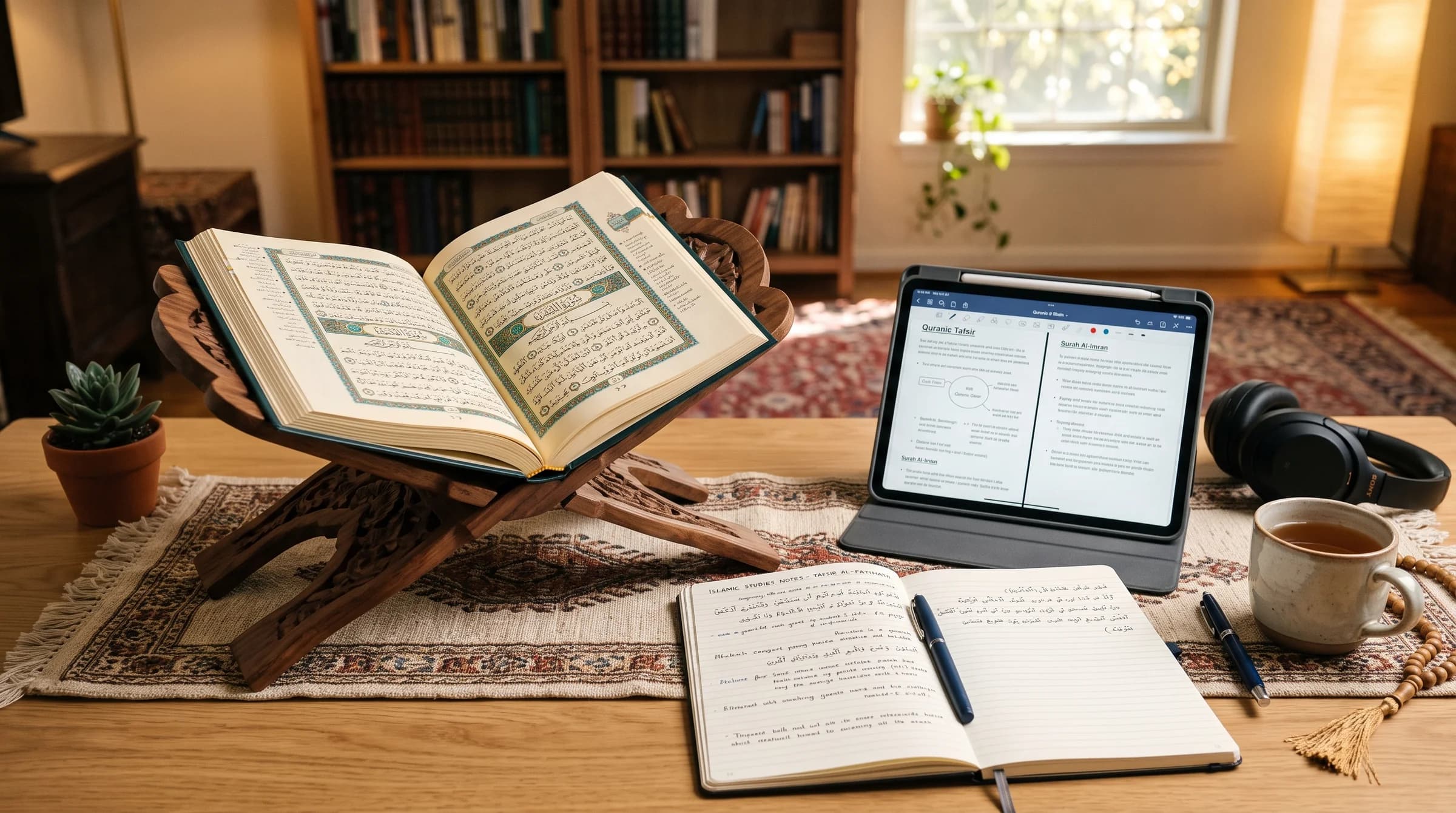
Plenty of people want to study the Quran on their own — around work and family, at their own pace, and without committing to a class straight away. The good news is that a lot can be learned independently: recognising the Arabic letters, building vocabulary, following a translation, reading gently from the Mushaf and keeping up steady revision. Independent study rewards consistency and puts you in charge of your own routine.
It also has real limits, and being honest about them saves time. Self-study works best with reliable sources and a clear goal, not a pile of random videos. And one area is genuinely hard to manage alone: because you cannot easily hear your own mistakes, accurate pronunciation, Makharij (the points of articulation) and applied Tajweed are usually more dependable once a qualified teacher has listened to you. This guide shows what you can do by yourself, how to do it well, and when a little teacher feedback makes the difference.
Can You Learn the Quran by Yourself?
Yes — up to a point, and it depends on what you mean by “learn”. It helps to separate two very different things: studying the Quran’s meaning and correcting your oral recitation.
Well suited to independent study: learning the Arabic letters and their shapes, building a basic vocabulary, reading a trustworthy translation, working through introductory Tafseer, memorising short Surahs you already read accurately, and daily revision. These are things you can genuinely do alone with good resources.
Where qualified correction strongly helps: pronunciation, Makharij, and applying Tajweed rules to live recitation. The problem is not effort — it is that you cannot reliably hear your own errors, and apps, recordings and books cannot catch every mistake the way a listening teacher can. Learning without a teacher is neither invalid nor impossible; it simply has a blind spot around recitation that is worth planning for.
Decide What You Want to Learn
“Learning the Quran” can mean several different goals, and they need different resources. Before you start, pick one:
- Recognising the Arabic letters — the foundation for everything else.
- Reading from the Mushaf — turning letters into fluent reading.
- Improving pronunciation — making individual sounds correctly.
- Studying Tajweed — the rules that govern accurate recitation.
- Memorising Surahs — committing passages to memory and revising them.
- Understanding translation and Tafseer — the meaning and context.
- Learning Quranic Arabic — the language itself, to understand directly.
You do not need all of these at once. Choosing one keeps your study focused; if you later want a full structured pathway, the beginner’s guide to learning the Quran online lays one out.
Assess Your Current Starting Level
Honest self-assessment prevents the single most common mistake: starting at the wrong level. Read the descriptions below and find yourself:
- Complete beginner — you do not yet recognise the Arabic letters. Start with the letters and their sounds, unhurried.
- You recognise the letters — you can name most letters but not yet join them smoothly. Work on connecting letters into words.
- Slow or hesitant reader — you read, but slowly and with frequent stops. Focus on short, repeated passages to build fluency.
- Reader with pronunciation problems — you read at a reasonable pace but suspect some sounds are off. This is where outside feedback matters most.
- Fluent reader seeking Tajweed — you read comfortably and want to apply the rules properly and consistently.
- Focused on meaning or memorisation — you read well and now want understanding or Hifz.
Return to this list every few weeks; the right starting point shifts as you improve.
How to Learn the Quran by Yourself, Step by Step
A simple, repeatable sequence works better than an ambitious plan you abandon:
- Set one specific goal. For example, “read Surah Al-Fatihah accurately” rather than “learn the Quran”.
- Choose a reliable Mushaf and one learning resource. Clear print and a recognised foundation text beat a dozen half-used apps.
- Begin at the correct level you identified above — not above it.
- Study in short, regular sessions. Fifteen to twenty focused minutes daily outperforms an occasional long push.
- Listen to careful recitation and follow along with the text, imitating the reciter slowly.
- Record and review your own reading. Hearing yourself back reveals hesitations and repeated slips you miss in the moment.
- Keep written notes and track mistakes so you can target the same weak spots next time.
- Review progress regularly against your one goal.
- Seek qualified feedback as soon as self-correction stops being enough — especially for pronunciation.
Notice there is no promised finish date. Progress depends on your level, your consistency and how quickly mistakes are caught — so aim for accurate, steady improvement rather than speed.
Build a Realistic Quran Self-Study Routine
Consistency matters far more than the occasional long session. A modest weekly framework you actually keep is worth more than an ambitious one you drop. For example:
- Session 1 — Reading or Qaida practice: work through your current level slowly and accurately.
- Session 2 — Listening and repetition: follow a careful reciter and imitate short portions.
- Session 3 — Vocabulary or meaning: a few words or a short passage of translation.
- Session 4 — Revision: revisit what you covered earlier in the week.
- Session 5 — Record and review: read aloud, record, and note what to fix.
- Weekly review: one short check of what improved and what still needs work.
Five short sessions a week is a realistic target for most people. If a week slips, simply start again — returning to the routine matters more than a perfect record. Learners who want a teacher-supported version of this can compare it with our step-by-step online study plan.
Reliable Resources for Independent Quran Study
Choose a small set of dependable resources rather than collecting everything. Useful categories include:
- A clearly printed Mushaf with legible script you find easy to read.
- A recognised foundation text such as Noorani Qaida for letters and basic phonics.
- Reliable recitation audio from a careful, well-known reciter to imitate.
- A trustworthy translation in a language you understand well.
- A recognised Tafseer for context, kept to introductory level at first.
- A vocabulary notebook to note recurring words — a step towards Quranic Arabic.
- A simple recording tool (your phone is enough) to review your own reading.
- Structured course material so your study follows a sensible order.
When you pick a specific app, translation, Tafseer or scholar, check its reputation first rather than trusting the top search result. For reading with the rules applied, a structured resource on Quran reading with Tajweed is more dependable than piecing together clips.
What Self-Study Cannot Easily Correct
Independent study has a few honest blind spots. Knowing them helps you plan around them rather than be discouraged:
- Unnoticed pronunciation mistakes — errors you cannot hear in your own voice.
- Incorrect Makharij — producing a letter from slightly the wrong place.
- Inconsistent Tajweed — knowing a rule in theory but not applying it reliably.
- Misreading a difficult verse — missing the meaning or context without guidance.
- Memorising an error — committing an inaccurate recitation to memory, which is hard to undo.
- No external accountability — nobody to notice a plateau or nudge you on.
None of this makes self-study pointless; it simply shows where an occasional listening ear is worth seeking.
When Should You Ask a Quran Teacher for Help?
A teacher can supplement your own practice rather than replace it. It is worth arranging some qualified feedback when:
- you cannot reliably distinguish similar Arabic sounds;
- you keep making the same mistake despite trying to fix it;
- your progress has clearly stalled;
- you understand Tajweed rules in theory but cannot apply them while reading;
- you are beginning serious Hifz and want to memorise accurately from the start;
- a child is learning and needs supervision and structured feedback;
- you are aiming for an Ijazah or advanced Qira’at study.
Even a few sessions of one-to-one feedback — or a focused Tajweed course — can correct habits that no amount of solo practice would catch, after which you carry on studying independently.
Common Self-Study Mistakes
Most difficulties come down to a handful of avoidable habits:
- Starting above your level and struggling needlessly.
- Using too many resources instead of finishing one.
- Relying entirely on transliteration rather than learning to read the Arabic script.
- Copying audio without understanding how each letter is articulated.
- Practising mistakes repeatedly until they become fixed habits.
- Studying irregularly — long gaps undo earlier gains.
- Prioritising speed over accuracy, which slows you down in the long run.
- Attempting Tafseer from unreliable sources.
- Memorising without revision, so new passages push out old ones.
A Four-Week Quran Self-Study Starter Plan
This is a starting framework, not a promise of fluency in a month. Its aim is to help you settle into a routine, spot your weak points and decide whether you need teacher support.
- Week 1 — Set up and assess. Choose your goal and resources, confirm your starting level, and begin short daily sessions at that level.
- Week 2 — Build the habit. Keep the five-session rhythm, add listening-and-repetition, and start recording yourself once.
- Week 3 — Target weaknesses. Review your recordings and notes, work on the sounds or passages that recur, and add light vocabulary or meaning.
- Week 4 — Review and decide. Assess what improved, note what self-correction could not fix, and decide whether a few sessions of qualified feedback would help.
By the end of four weeks you should have a working routine and a clear, honest sense of where you stand — which is worth far more than a rushed sense of completion.
How QuranHost Can Support Independent Learners
Independent study and a teacher are not either/or — many learners study on their own and add occasional or regular live correction for the parts that are hard to self-check. QuranHost can support that with a level assessment, one-to-one recitation feedback, a choice of male or female teachers, and course selection based on your actual level rather than a fixed template. If you would like to test your reading with a teacher before deciding anything, you can book a free trial class — the regular lessons are separate and paid.
Conclusion
Learning the Quran by yourself is a genuine and rewarding path: on your own you can build real knowledge, steady habits and a growing familiarity with the text. What makes it work is choosing reliable resources, assessing yourself honestly, and seeking timely correction for the things — chiefly pronunciation and applied Tajweed — that are hard to judge alone. Combine consistent practice with feedback when you need it, and independent study becomes something you can trust rather than second-guess.