


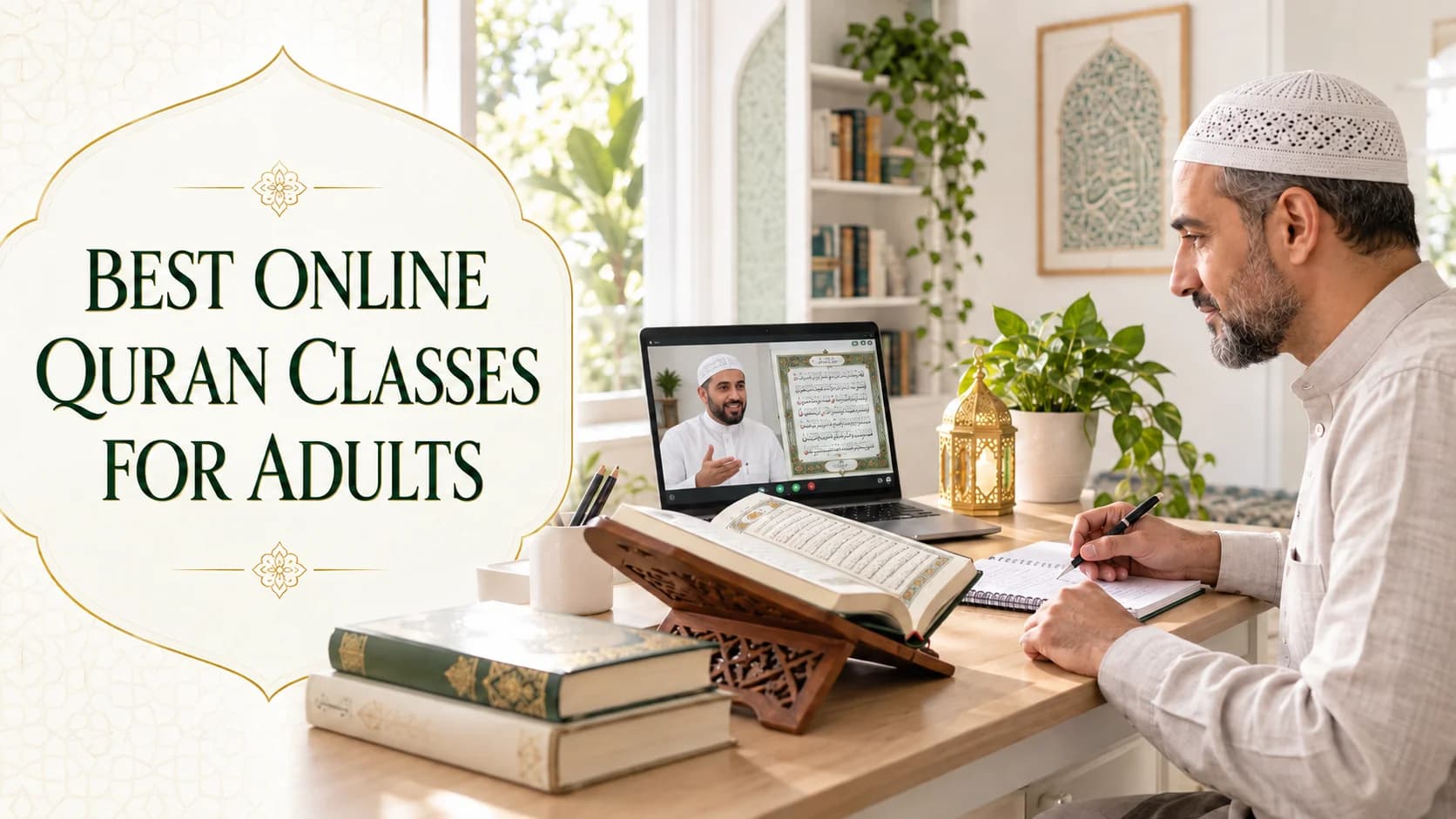
It is never too late to learn the Quran. Plenty of adults come to it for the first time, or return to it years after childhood lessons — and online classes have made that far easier to fit around real life. Adults who benefit from online Quran classes include those who:
- never learned to read the Quran
- learned as a child but have since forgotten
- can read but need their pronunciation corrected
- want to study Tajweed more systematically
- want to begin Hifz, Tafseer or Quranic Arabic
- prefer a female teacher
- need lessons that work around a job or family
Wherever you sit on that list, this guide explains what online Quran classes for adults involve, their benefits, the learning paths available, and how to start at the right level. You will not be judged for beginning late or for starting with the basics — the aim is simply steady, correct progress.
Who Are Online Quran Classes for Adults Suitable For?
Adults arrive with very different starting points, and the right class depends on yours:
- Complete beginners who do not yet recognise the Arabic letters
- Rusty readers who learned long ago and need to rebuild fluency
- Readers with mistakes who read but slip on pronunciation
- Improvers who read well and want structured Tajweed
- Memorisers beginning or revising Hifz
- Seekers of meaning who want Tafseer or Quranic Arabic
- Reverts and new Muslims starting with the essentials for Salah
None of these is “too basic” or “too advanced” — each simply has a suitable starting course. A short assessment is the quickest way to know which fits you.
Your goal matters as much as your level: two adults who read equally well may need different courses if one wants Tajweed precision and the other wants to memorise. Knowing your main goal first makes the choice much clearer.
Benefits of Online Quran Classes for Adults
Online lessons remove many of the barriers that stop busy adults from learning. The most useful benefits include:
- Flexible scheduling — lessons early, late or at weekends, around work and family.
- Learning from home — no commute to a class after a long day.
- Privacy — you can start from the basics without feeling self-conscious in front of a group.
- One-to-one correction — a teacher listens to you alone and corrects each letter.
- Lessons matched to your level — you begin exactly where you are, not where a fixed class happens to be.
- A male or female teacher — you can request the option you are comfortable with.
- Consistency and accountability — a regular slot and a teacher tracking your progress help you keep going.
- Learning that travels — you can continue while working away or on the move.
These are reasonable advantages for most adults, not guarantees; progress still depends on regular lessons and practice.
Choose the Right Quran Learning Path
Adult learners generally follow one of these paths. Pick the one that matches your current level and goal.
Arabic letters and Noorani Qaida
If you cannot yet read the Arabic letters, start here. Noorani Qaida builds the letters, joined forms, vowels and reading signs in order, and it suits adult beginners just as well as children. Expect to move from recognising letters to reading simple words and short verses with practice. If you are starting from zero, our beginner’s guide walks through the full pathway.
Quran reading with practical Tajweed
Once the letters are secure, you move to reading from the Mushaf while applying Tajweed as you go, with a teacher correcting mistakes. This suits adults who know the letters but read slowly or hesitantly and want smooth, accurate recitation. See Quran reading with Tajweed.
Advanced Tajweed study
Adults who already read well can study the rules in depth — Makharij, Madd, Ghunnah and the rest — through a dedicated Tajweed course. It suits confident readers who want their recitation to be precise, not merely correct.
Quran memorisation and revision
For those who want to commit portions to memory, a structured Hifz programme covers new memorisation and regular revision at a manageable pace. It suits adults memorising for the first time as well as those revising portions learned years ago — accurate reading should come first.
Tafseer and understanding the Quran
To understand meaning and context rather than only recite, an introductory Tafseer course is a good next step — and you do not need fluent Arabic to begin. It suits adults who can already read and want the Quran’s message to come alive, not only its recitation.
Arabic and Quranic Arabic
Learning Arabic deepens your understanding of the Quran, though it is not required before you start reading. It suits learners who want to recognise Quranic vocabulary and, in time, follow the meaning without leaning on a translation.
Islamic learning for adult Muslims and reverts
Beyond recitation, online Islamic teaching covers beliefs, worship, essential Duas and practical guidance — useful foundations for adult Muslims and new Muslims building knowledge alongside their reading.
How Online Quran Lessons for Adults Usually Work
Online Quran programmes for adults commonly include some or all of the following:
- Initial assessment — a short session to identify your level and starting course.
- Live lessons — you and the teacher meet by video call at your scheduled time.
- One-to-one correction — the teacher listens as you recite and corrects mistakes on the spot.
- Regular frequency — commonly two to four lessons a week, chosen to fit your routine.
- Practice between lessons — short daily practice is where most progress is made.
- Progress feedback — the teacher tracks how you are doing and what to work on next.
You need very little equipment: a laptop, tablet or phone, a stable internet connection, a headset for clear audio, and a quiet space. Lessons run on a video platform such as Zoom, or whichever tool the academy currently uses.
The initial assessment matters most: it stops an adult beginner being placed in a class that is too advanced, and stops a capable reader wasting time on material they have already outgrown.
How Much Time Should an Adult Set Aside?
Consistency matters more than long sessions. A realistic pattern for many adults is two or three lessons a week of around 30–45 minutes, plus a little daily practice. Even ten focused minutes between lessons can be easier to sustain and more useful for building a regular learning habit. The simplest way to build the habit is to attach practice to something you already do each day — after Fajr, during a regular break, or before bed. A short, protected slot you actually keep beats an ambitious plan you abandon after a fortnight.
How quickly you progress depends on your starting level, how often you attend and how much you practise, so it is best to think in steady stages rather than fixed deadlines.
How to Choose the Best Online Quran Classes for Your Needs
The best online Quran class for an adult is not necessarily the most expensive or heavily advertised option. It is the class that matches your current level, learning goal, preferred teacher, available schedule and need for individual correction.
The teacher makes a bigger difference than the brand. Look for:
- solid Quran recitation and Tajweed knowledge
- the ability to explain clearly in a language you understand
- patience with adult beginners
- consistent correction and feedback
- the male or female teacher you prefer
- a trial or assessment lesson before you commit
- a schedule that genuinely fits yours
Ask what a specific teacher is qualified to teach rather than assuming one certificate covers everything. QuranHost offers both male and female tutors, and many adults request a female teacher. If you want to weigh up providers more broadly, see our guide on how to choose an online Quran class. A good teacher for an adult also explains the reason behind each correction, so you learn the rule rather than only copying the sound.
Common Concerns Adults Have Before Starting
A few worries come up again and again — and none should hold you back:
- “Am I too old?” No. Adults can make steady progress when lessons match their level and they practise consistently.
- “Will I have to start with Qaida?” Only if you need to. An assessment places you at your real level.
- “I feel embarrassed about my reading.” One-to-one lessons are private, and teachers are used to helping adults begin.
- “I have a busy schedule.” Flexible timings let you fit lessons around work and family.
- “Can I request a female tutor?” Yes, subject to availability.
- “How quickly will I progress?” That varies from person to person. Regular attendance and consistent practice provide a clearer path forward than studying irregularly.
How to Start Learning with QuranHost
Getting started is straightforward:
- Request a trial or assessment so a teacher can hear where you are.
- Let the teacher identify your starting level and recommend a course.
- Choose the course and a schedule that fit your week.
- Continue with regular lessons and practice, adjusting as you progress.
You can book a free trial to get a recommendation before committing, and see plans on the pricing page.