


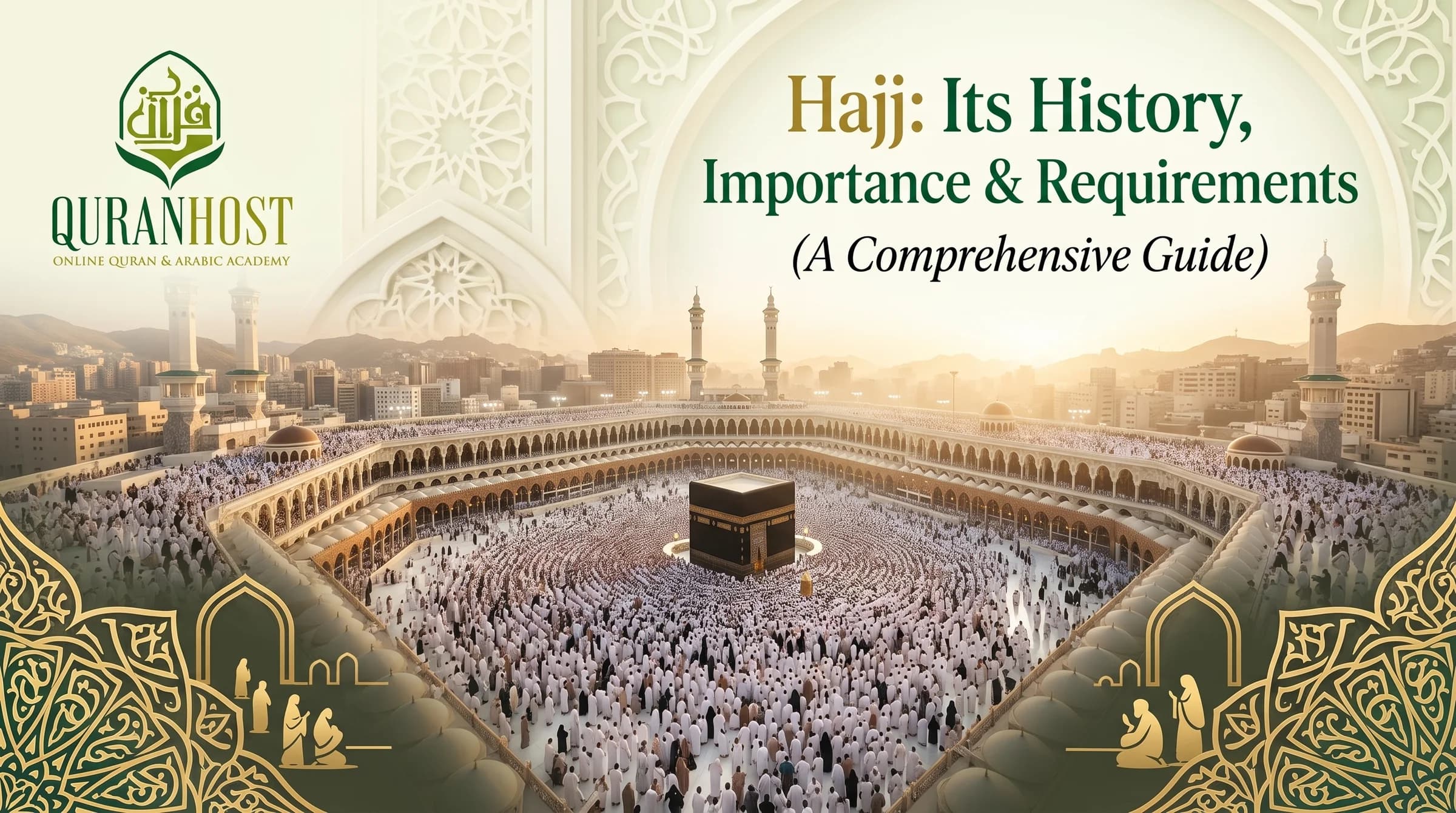
Hajj is important because it is the one act of worship that gathers a Muslim's whole self, body, wealth, time and intention, into a single journey made once in a lifetime. It is the fifth pillar of Islam, and the only pillar that many Muslims will perform exactly once.
Prayer is daily, fasting is annual, zakat is a yearly calculation, and the declaration of faith is said in a moment. Hajj asks for something different: leaving home, spending what you have saved, wearing what everyone else wears, and standing in a crowd where nothing distinguishes you from anyone else.
This article explains what Hajj is, who is required to perform it, and why Muslims treat it as one of the defining experiences of a believing life. For how the pilgrimage is actually performed, see our step-by-step guide to performing Hajj.
What Hajj is, and where it sits among the five pillars
Hajj is the annual pilgrimage to the Kaaba in Makkah, performed in the month of Dhul Hijjah. The Prophet (peace be upon him) described the structure of the religion in a well-known report: Islam is built on five, the testimony of faith, establishing prayer, giving zakat, Hajj, and fasting Ramadan (Sahih al-Bukhari 8).
Its place in that list is worth noticing. The other four are recurring: they shape a day, a month, a year. Hajj is required once in a lifetime, and only of those able to make it. That makes it the pillar most Muslims spend years preparing for and think about long before they perform it.
A point that is often blurred: the five pillars of Islam are not the same thing as the essential rites within Hajj, which scholars also call pillars, arkan. Standing at Arafat is a pillar of Hajj. It is not a pillar of Islam. The two lists answer different questions.
The Kaaba itself is not worshipped. Muslims face it in prayer as a shared direction, and worship is directed to God alone.
Who is required to perform Hajj
The obligation is stated in the Quran with its condition attached:
وَلِلَّهِ عَلَى ٱلنَّاسِ حِجُّ ٱلْبَيْتِ مَنِ ٱسْتَطَاعَ إِلَيْهِ سَبِيلًا“Pilgrimage to this House is an obligation by Allah upon whoever is able among the people.” (Quran 3:97)
That word, able, carries the whole ruling. Istita'ah, capability, is usually explained as covering:
- Islam, adulthood and sound mind. A child's Hajj is valid and rewarded but does not discharge the obligation once they reach adulthood.
- Physical ability to make the journey and bear its exertion.
- Financial means that are genuinely surplus: enough for the travel and for the maintenance of your dependants while you are away, after debts.
- A safe and practicable route, including being able to obtain the necessary permissions.
Two qualifications matter and are often lost. First, this is once in a lifetime; further pilgrimages are voluntary. Second, someone who does not meet these conditions is not sinning by not performing Hajj. It is not an obligation on the poor, and describing it as a duty of the wealthy misses the point: the test is capability, not affluence.
Where a person has the means but is permanently unable to travel through age or illness, scholars discuss Hajj performed on their behalf. That is a question for a qualified scholar rather than an article.
Five things that make Hajj matter
What follows is our own way of grouping the themes that run through the Quran and the reports about Hajj. It is an explanation, not a fixed list that anyone is required to hold.
1. It is obedience before it is experience
The first answer to why Hajj matters is the plainest: God commanded it. The call in the Quran is addressed to Ibrahim (peace be upon him) and through him to everyone after:
وَأَذِّن فِى ٱلنَّاسِ بِٱلْحَجِّ يَأْتُوكَ رِجَالًا“Call people to the pilgrimage. They will come to you on foot.” (Quran 22:27)
Pilgrims often describe Hajj as moving, and it frequently is. But its weight does not rest on how it feels. A person who finds it exhausting and unremarkable has still fulfilled it.
2. It offers a genuine fresh start, on conditions
The Prophet (peace be upon him) said that whoever performs Hajj and commits no obscenity or transgression returns as on the day his mother bore him (Sahih al-Bukhari 1521), and that an accepted Hajj, hajj mabrur, has no reward but Paradise (Sahih al-Bukhari 1773).
The conditions in those words are part of the promise, not decoration. The forgiveness described attaches to a Hajj that is accepted: performed sincerely, funded lawfully, and kept free of sin during it. Scholars add that it does not cancel debts, expiations or rights owed to other people, which have to be settled with those they are owed to (Islam Question and Answer on what Hajj does and does not wipe out). Nobody can guarantee that any particular Hajj has been accepted.
3. It keeps one family's story alive
Several rites retrace the trial of Ibrahim, Hajar and Ismail (peace be upon them). Sahih al-Bukhari preserves the account: left in an empty valley with her infant and her water gone, Hajar climbed Safa, then Marwa, going back and forth seven times looking for help, until an angel struck the ground at the place of Zamzam and water flowed (Sahih al-Bukhari 3364). The Prophet (peace be upon him) said this is the origin of the walking between the two, and the Quran names them among the symbols of God (Quran 2:158).
The sacrifice offered during Hajj recalls Ibrahim's readiness to give up his son, and the ransom God sent in his place. What the pilgrimage preserves is not a set of ruins but the conduct of a family under pressure: a woman who kept moving when there was no reason to hope, and a father who did not bargain.
4. It strips away rank
In ihram, a man wears two plain unstitched cloths. Wealth, office and nationality stop being visible. Millions of people perform the same movements in the same place at the same time, and no one's position in the crowd reflects their standing at home.
This is the aspect pilgrims most often describe afterwards, and it is not merely sentimental. It is a practical lesson in what Islam claims about people: that the distinctions everyone else organises life around do not count for much.
5. It is measured by what happens afterwards
Hajj is physically hard. Crowds, heat, queues and sleeping in tents are part of it, and patience under those conditions is part of the worship rather than an obstacle to it.
The real test comes later. A pilgrimage that leaves someone's temper, honesty and treatment of their family exactly as they were has not changed much. Scholars discussing hajj mabrur commonly note that one of its signs is that a person does not return to the disobedience they left.
A short history of the pilgrimage
The Quran describes the Kaaba as raised by Ibrahim and his son Ismail (peace be upon them), and pilgrimage to it long predates Islam. By the time of the Prophet (peace be upon him) the practice had continued among the Arabs but had taken on idolatry, and the sanctuary held idols.
The pilgrimage was restored to the worship of God alone at the conquest of Makkah, and the Prophet (peace be upon him) performed Hajj once, in the year known as the Farewell Pilgrimage, where he delivered the sermon at Arafat. That Hajj is the model from which the rites are taken.
We have deliberately avoided putting precise dates on the earlier history. Figures such as “four thousand years ago” circulate widely but are not established, and the same applies to the Kaaba's original dimensions.
How the rites carry these lessons
This is not a performance manual. Our step-by-step guide to performing Hajj covers the sequence properly. What follows is only what a few of the rites express.
- Ihram is not the clothing. It is a state a pilgrim enters by intention, at or before a fixed boundary, after which things ordinarily permitted, such as perfume, cutting hair or nails, hunting and marital relations, become forbidden until the pilgrim leaves the state. Putting on the garments without that intention does not put a person into ihram (Islam Question and Answer on the intention for Hajj). The white cloth is the visible sign of it.
- Tawaf, circling the Kaaba seven times, orients the pilgrim around a single point and a single object of worship.
- Sa'i, walking between Safa and Marwa, repeats Hajar's search.
- Standing at Arafat on the 9th of Dhul Hijjah is the essential rite: a Hajj is not valid without it. Pilgrims spend the afternoon in supplication. It is a rite in its own right, not a re-enactment of the Farewell Sermon, which happened to be delivered there.
- Muzdalifah and the stoning at Mina follow, the stoning expressing the rejection of temptation.
- The sacrifice and Tawaf al-Ifadah are two separate rites, often confused. The sacrifice is the offering of an animal; Tawaf al-Ifadah is a circling of the Kaaba that is itself a pillar of Hajj. Performing one does not discharge the other.
Hajj and Umrah are not the same
Umrah is sometimes called the lesser pilgrimage. It shares ihram, tawaf and sa'i, but it can be performed at any time of year, takes a few hours rather than several days, and does not include Arafat, Muzdalifah or the stoning. It does not discharge the obligation of Hajj.
One further point, because it causes real confusion: visiting Madinah is not part of Hajj. Visiting the Prophet's Mosque is virtuous and most pilgrims include it in the trip, but it is not a rite of the pilgrimage and a Hajj without it is complete.
Carrying Hajj home
The strongest argument for why Hajj matters is what it is supposed to leave behind. The pilgrim comes back to the same job, the same household and the same difficult relative. The pilgrimage is a concentrated version of what Islam asks every day: put God first, hold your temper, spend on others, be patient with people who are in your way.
If you want to go further into the passages the pilgrimage is built on, see our article on Quran verses about Hajj and what they really mean.
Hajj: Frequently Asked Questions
Direct answers on the obligation, its conditions and what the pilgrimage means.
Sources
The claims above were checked against these published sources. This article is general information and has not been reviewed by a named scholar; for a ruling on your own circumstances, ask a qualified scholar.
- Quran 3:97, Quran 22:27 and Quran 2:158, Quran.com
- Sahih al-Bukhari 8, Islam built on five
- Sahih al-Bukhari 1521 and Sahih al-Bukhari 1773, the reward of an accepted Hajj
- Sahih al-Bukhari 3364, the account of Hajar, Ismail and Zamzam
- Islam Question and Answer on what Hajj does and does not wipe out
- Islam Question and Answer on the intention for Hajj