


Published: 19 May 2023 · Last updated: 23 July 2026
Written by: QuranHost Editorial Team
Sourcing: every Quranic reference in this article has been checked against the Arabic text and a recognised translation, and hadith gradings are attributed to the source cited in the References section.
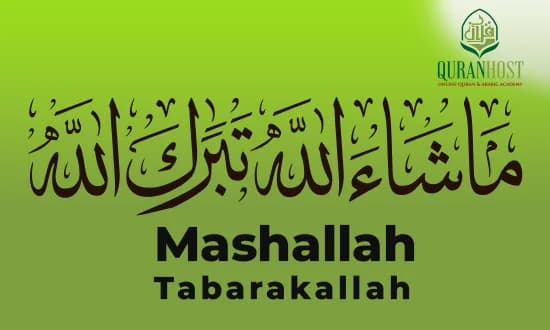
MashaAllah TabarakAllah (مَا شَاءَ ٱللَّٰهُ تَبَارَكَ ٱللَّٰهُ) is an Arabic expression used to acknowledge that something good exists by Allah’s will, and to praise Allah as the source of every blessing. MashaAllah means “what Allah has willed”; TabarakAllah means “blessed and exalted is Allah.” Muslims say it when admiring a child, an achievement, a home, or any favour — giving credit to Allah rather than to the person or the thing itself.
Key Takeaways
- MashaAllah acknowledges that something happened by Allah’s will.
- TabarakAllah praises Allah’s greatness and abundant blessing — it is not a way of thanking a person.
- The two phrases are related but not identical, and neither is a synonym for “thank you.”
- Both may be said together when admiring a blessing.
- When admiring something that belongs to someone else, the guidance supported by authentic evidence is to pray for blessing: Allahumma barik (“O Allah, bless it”).
What Does MashaAllah Mean?
Arabic: مَا شَاءَ ٱللَّٰهُ | Transliteration: Mā shāʾ Allāh
MashaAllah is usually rendered as “what Allah has willed,” “as Allah has willed,” or “this is what Allah has willed.” It recognises that a blessing, achievement or beauty exists because Allah willed it — not because of the person’s own power.
Quranic basis
The wording appears in the parable of the two garden owners. One man boasts about his wealth, and his companion rebukes him:
“If only you had said, upon entering your property, ‘This is what Allah has willed!’”
— Surah Al-Kahf 18:39 (Dr. Mustafa Khattab, The Clear Quran)
The lesson is about attributing blessings to Allah instead of to oneself. Saying MashaAllah keeps admiration free of arrogance and envy.

What Does TabarakAllah Mean?
Arabic: تَبَارَكَ ٱللَّٰهُ | Transliteration: Tabārak Allāh
TabarakAllah means “blessed is Allah,” “exalted and full of blessing is Allah,” or “Allah is blessed and exalted.” The verb comes from the root b-r-k (ب ر ك), connected to barakah — blessing, abundance and lasting good.
Applied to Allah, the word carries the sense of greatness, exaltedness and perfection: Allah is the source of blessing, not a recipient of it.
Quranic basis
“… Blessed is Allah, Lord of all worlds!”
— Surah Al-A’raf 7:54 (ending with تَبَارَكَ ٱللَّٰهُ)
A similar construction opens Surah Al-Mulk (67:1): “Blessed is the One in Whose Hands rests all authority.”
An important correction: TabarakAllah is not a way of thanking a person, and it does not mean the same as shukran (“thank you”). It is praise directed to Allah. To thank a person, Muslims commonly say JazakAllahu khayran (“may Allah reward you with good”).
What Does MashaAllah TabarakAllah Mean Together?
Together, the expression means roughly “What Allah has willed; blessed and exalted is Allah.” It combines two acts: acknowledging that the blessing came about by Allah’s will, and praising Allah as the One who is blessed and exalted. English renderings vary, and no single translation is the only correct one.
Difference Between MashaAllah and TabarakAllah
| Phrase | Arabic | Meaning | Main purpose | Example |
|---|---|---|---|---|
| MashaAllah | مَا شَاءَ ٱللَّٰهُ | What Allah has willed | Acknowledging Allah’s will behind a blessing | “MashaAllah, your son has done well.” |
| TabarakAllah | تَبَارَكَ ٱللَّٰهُ | Blessed and exalted is Allah | Praising and glorifying Allah | “TabarakAllah, the sky looks magnificent.” |
| Allahumma barik | اللَّهُمَّ بَارِكْ | O Allah, bless it/them | A du’a asking Allah to place blessing in something | “MashaAllah, Allahumma barik.” |
The first two are statements of belief and praise. The third is a supplication — which is why it is often added when admiring something that belongs to another person.
When Should You Say MashaAllah TabarakAllah?
It is said whenever a blessing is noticed — your own or someone else’s. Common occasions include:
- Seeing a newborn or a healthy, well-behaved child
- Hearing beautiful Quran recitation
- Congratulating someone on academic or career success
- Admiring a home, garden or scenery
- A marriage, or recovery from illness
- Commenting on a photo or achievement on social media
A useful distinction: when the blessing is your own, MashaAllah expresses gratitude and guards against self-satisfaction. When it belongs to someone else, it is good practice to add a prayer for blessing — Allahumma barik — as explained below.
MashaAllah, TabarakAllah and the Evil Eye
Saying MashaAllah is virtuous because it attributes the blessing to Allah, but it should not be presented as an automatic or guaranteed shield against the evil eye. That is a widespread misunderstanding worth stating plainly.
The evil eye itself is affirmed in authentic narrations — the Prophet Muhammad ﷺ said, “The evil eye is real” (Sahih al-Bukhari; Sahih Muslim).
Where the guidance is clearest is in what to say when you admire something belonging to another person. In the well-known incident involving Sahl ibn Ḥunayf, whose companion’s admiring words were followed by his falling ill, the Prophet ﷺ asked: “If you see something that you like, why do you not pray for blessing for it?” (Musnad Aḥmad).
By contrast, the narration sometimes quoted to prescribe “Mā shāʾ Allāh, lā quwwata illā billāh” specifically as protection against the evil eye is classified as very weak (ḍaʿīf jiddan) by al-Haythamī. So the sound position is straightforward: keep saying MashaAllah as an acknowledgement of Allah, and add a du’a for blessing when praising what belongs to others.
Should You Say MashaAllah or Allahumma Barik?
They serve different functions, so they are not interchangeable — and a Muslim may say both.
- MashaAllah is a statement: it acknowledges that Allah willed this blessing.
- Allahumma barik (اللَّهُمَّ بَارِكْ) is a request: it asks Allah to place blessing in the thing admired.
When admiring another person’s child, home or success, combining them is both natural and well-founded: “MashaAllah, Allahumma barik.”
How Do You Reply to MashaAllah TabarakAllah?
There is no single obligatory reply. Any of these is appropriate depending on the situation:
- JazakAllahu khayran — “May Allah reward you with good.”
- BarakAllahu feek — “May Allah bless you.”
- Ameen — if the speaker made a du’a for you.
- Alhamdulillah — returning the praise to Allah.
- A simple thank-you followed by praise of Allah.
Note that BarakAllahu feek (“may Allah bless you”) is a du’a for a person and is not the same phrase as TabarakAllah, which is praise of Allah.
Correct Spelling and Transliteration
Arabic sounds can be represented in English in several ways, so more than one spelling is acceptable. Common variants include:
- MashaAllah, Mashallah, Ma Sha Allah, Mā shāʾ Allāh
- TabarakAllah, Tabarakallah, Tabārak Allāh
None of these is “wrong” in itself — they are different transliteration conventions. This article uses MashaAllah and TabarakAllah consistently. What matters more than the Latin spelling is the correct Arabic pronunciation, which is best learned with a teacher through an Arabic language course.
Can Non-Muslims Say MashaAllah?
Yes — there is no clear evidence prohibiting it. The phrase is Islamic in origin and meaning, and it is widely used as everyday vocabulary in Muslim-majority societies, including by non-Muslims living among them.
What matters is intent and respect. Using the phrase sincerely or culturally is quite different from using it mockingly. Claims that non-Muslims are forbidden from saying it are not supported by clear evidence, and this article does not make that claim.
Common Misconceptions
| Misconception | Accurate position |
|---|---|
| Both phrases mean the same thing | Related but distinct: one acknowledges Allah’s will, the other praises Allah |
| TabarakAllah means “thank you” | It is praise of Allah, not thanks to a person; shukran means thank you |
| Saying MashaAllah guarantees protection from harm | It is virtuous, but not an automatic shield; praying for blessing is the better-supported practice |
| Non-Muslims may not use the phrase | No clear evidence prohibits respectful use |
| There is only one correct English spelling | Transliteration varies legitimately |
| You must reply with one specific sentence | Several replies are appropriate; none is obligatory |
| The combined phrase appears in the Quran as one expression | Each element appears separately (18:39 and 7:54); the combined phrase is common Muslim usage, not a Quranic verse |
Conclusion
MashaAllah TabarakAllah is a concise way of saying that a blessing came about by Allah’s will and that Allah alone is blessed and exalted. Used accurately, it keeps admiration free of pride and envy — and when praising what belongs to someone else, adding Allahumma barik follows the better-supported guidance.
To understand expressions like these in their proper Quranic context, you can explore QuranHost’s online Quran, Tajweed and Arabic classes, including our Tafseer course for deeper study of meaning.
Related Reading
- The power of du’a in Islam — why supplication sits at the heart of Muslim practice.
- Essential Ramadan du’as — supplications with meanings and transliteration.
- Du’as for Hajj and Umrah — what to recite during the pilgrimage.
References
- The Quran, Surah Al-Kahf 18:39 — quran.com (translation: Dr. Mustafa Khattab, The Clear Quran)
- The Quran, Surah Al-A’raf 7:54 — quran.com
- The Quran, Surah Al-Mulk 67:1 — quran.com
- Narrations on the evil eye and praying for blessing — Sahih al-Bukhari, Sahih Muslim and Musnad Ahmad; see IslamQA 7190 for the discussion of gradings referenced above.
This article is general educational information about the meaning and use of an Arabic expression. For rulings on a specific situation, consult a qualified scholar.